Nowadays, documentary films not only chronicle events but also provide space for profound reflection and real people’s stories. Instead of giving ready-made answers, they teach to pose questions, discuss, think critically, and find one’s own stance.
Reprinted from Vchysia media.
-
How to turn documentary films into tools for education?
-
What should educators keep in mind before, during, and after the screening?
-
How to use documentary films to discuss human rights, empathy, critical thinking, and other complex issues with students?
These questions were discussed by Maria Symkovych, the author and editor of the methodological guidebook “Implementing Docudays UA human rights documentary films into the process of education,” educator, and moderator of the Docudays UА film club at the NGO “‘Insider’ Center for Education,’” and Olha Babchuk, journalist and communications manager of the DOCU/CLUB Network.
For those who couldn’t join the discussion, we’ve prepared a brief summary of the conversation. The video is available at the link.
DOCUMENTARY FILMS AT SCHOOL LESSONS: HOW EDUCATORS CAN USE THEM
Documentary films help children understand complex topics through practice rather than theory, as they learn from the stories of real people. However, to achieve the desired effect, a mere screening of the film is not enough.
Preparing the class for the screening
To ensure that children truly enjoy watching the film, Maria Symkovych recommends asking them to share their expectations: what they think the film will be about, what associations the title evokes, and what themes might the plot address. This approach sets the stage for active engagement.
Next, ask the children to take notes on interesting lines, moments, and scenes they see during the screening. These notes will subsequently serve as the basis for discussion and help children articulate their thoughts with grounded arguments. This exercise ensures that watching the film isn’t merely entertainment, but a conscious and meaningful experience.
Emphasize that every opinion is valuable. Students should be able to freely share their impressions, ask questions, or express different points of view. This is one of the core values of documentary film: often, it does not provide ready-made answers but creates space for discussion, reflection, and the formation of one’s own position.
In this process, the teacher should first and foremost be a facilitator — someone who creates a space for open discussion rather than imposes a single “correct” opinion. Children should feel that they can freely express their views without fear of being judged or ridiculed.
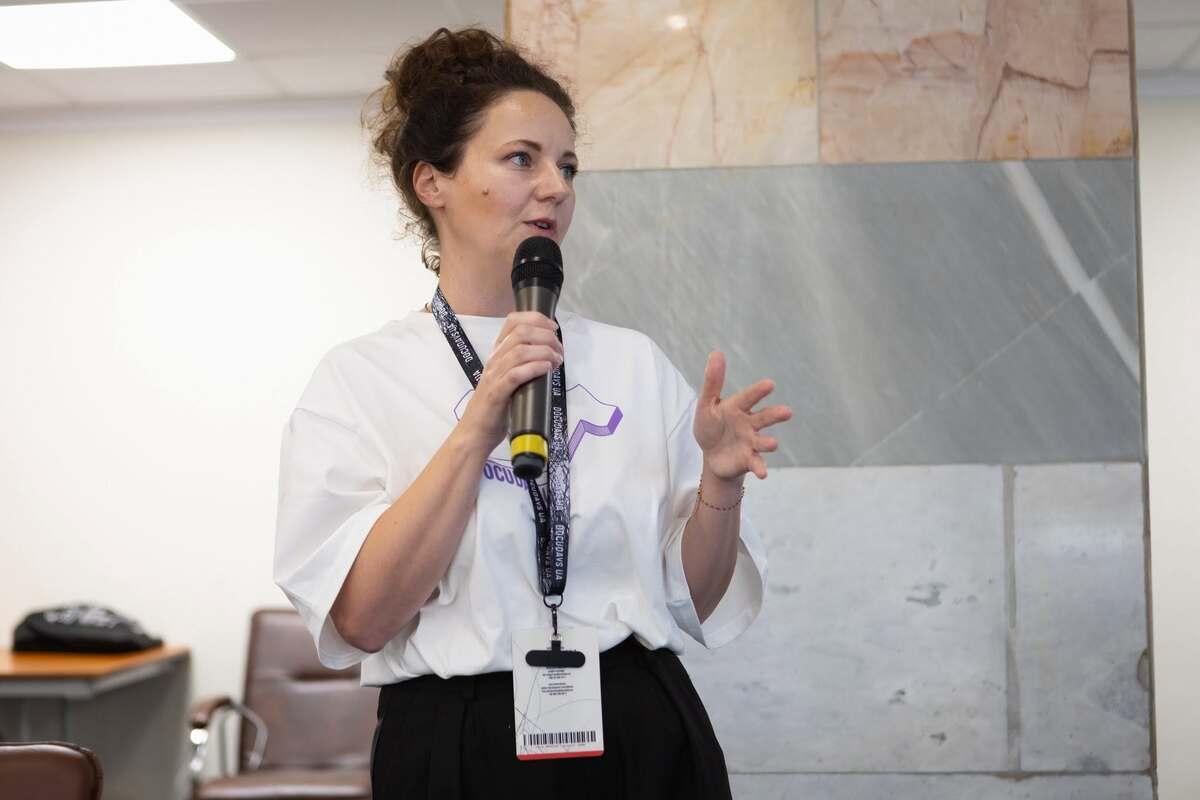
Photo: Maria Symkovych
Working with students after the screening
To ensure effective learning after watching the film, Maria Symkovych suggests using modern digital tools, such as Mentimeter or Kahoot. They help quickly organize the survey, create a word cloud or a mind map, and lead an interactive discussion.
Different topics can be addressed at different lessons, depending on the content of the film. For instance, if the film addresses a language-related issue, the discussion can be integrated into lessons of Ukrainian language and literature, history, legal, or civic education, focusing on different aspects of the issue.
Thus, in Ukrainian language and literature classes, it is advisable to address issues of linguistic identity and the role of language in a person’s life. Moreover, students can identify verbs, adjectives, and nouns that describe the film’s events, characters, or atmosphere. They can also analyze the characters’ speech, paying attention to the peculiarities of their communication, intonation, and stylistic devices.
In history, law, or civics classes, it is advisable to focus on the historical and legal aspects of the development of the Ukrainian language: work with primary sources, analyze the Valuev Circular, the Ems Decree, and the Law of Ukraine “On Language,” as well as discuss various issues of language policy.
After the discussion, the educator can ask students to write an essay about their own perception of the film: how they understood its content, what issues they noticed, what consequences they see for these issues, and what conclusions they drew for themselves.
Another distinctive feature of documentary film is that it not only informs but also motivates action and change within one’s own community. That is why, after watching the film, students can create pet projects aimed, for example, at supporting the Ukrainian language at the school, community, or city level. These could include awareness campaigns, language initiatives, themed events, and so on.
Documentary films make learning more vivid. Today, children need not only theoretical information but also emotions, impactful stories, and real-life examples. When they see other people’s experiences, it inspires them, helps them better navigate complex problems, and encourages them to open up in conversations. Often, it is easier for students to talk about other people’s difficulties; through this, they gradually come to terms with their own experiences.
More methodological advice on using documentaries in school lessons is available in the methodological guidebook at the link. The guidebook includes:
-
94 lesson plans based on films;
-
A collection of universal group exercises;
-
Advice on psychological preparation;
-
A collection of digital resources that help conduct an online film club or collect feedback from students;
-
Resources on the legal framework for human rights;
-
Additional sections on student self-governance, the work of school psychologists, career guidance, professional orientation, and administrative and methodological work.
THINGS TO KNOW ABOUT THE DOCU/CLUB NETWORK’S DOCUMENTARY FILMS COLLECTION
The DOCU/CLUB Network's collection comprises over 150 documentary films. To gain free access to them, you should open a film club at your educational institution using the link. After you fill in the application form, the team will contact you to coordinate the next steps.
Each film page on the website is assigned age categories indicating the most appropriate audience for viewing the film, includes suggested discussion topics, and features lesson plans with various activities.
The project is implemented with the support of the DOCU/CLUB Network, funded by the Embassy of Sweden in Ukraine and Fondation de France.
The opinions, conclusions or recommendations are those of the authors and compilers of this publication and do not necessarily reflect the views of the governments or charitable organizations of these countries. The authors and compilers are solely responsible for the content of this publication.