
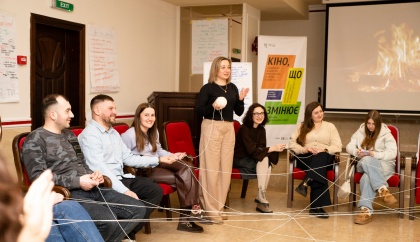
In order to change communities’ lives for the better, enthusiastic moderators need effective tools, knowledge of legislation, and the ability to reach the hearts and minds of decision-makers. This was the goal of the three-day Advocacy School for participants of the DOCU/CLUB Network’s advocacy projects, which took place in Lviv on February 5-7.
The teams of ten advocacy projects of the DOCU ACTS 5.0 Programme dived into an intensive training process, where each day introduced a new facet of community impact.
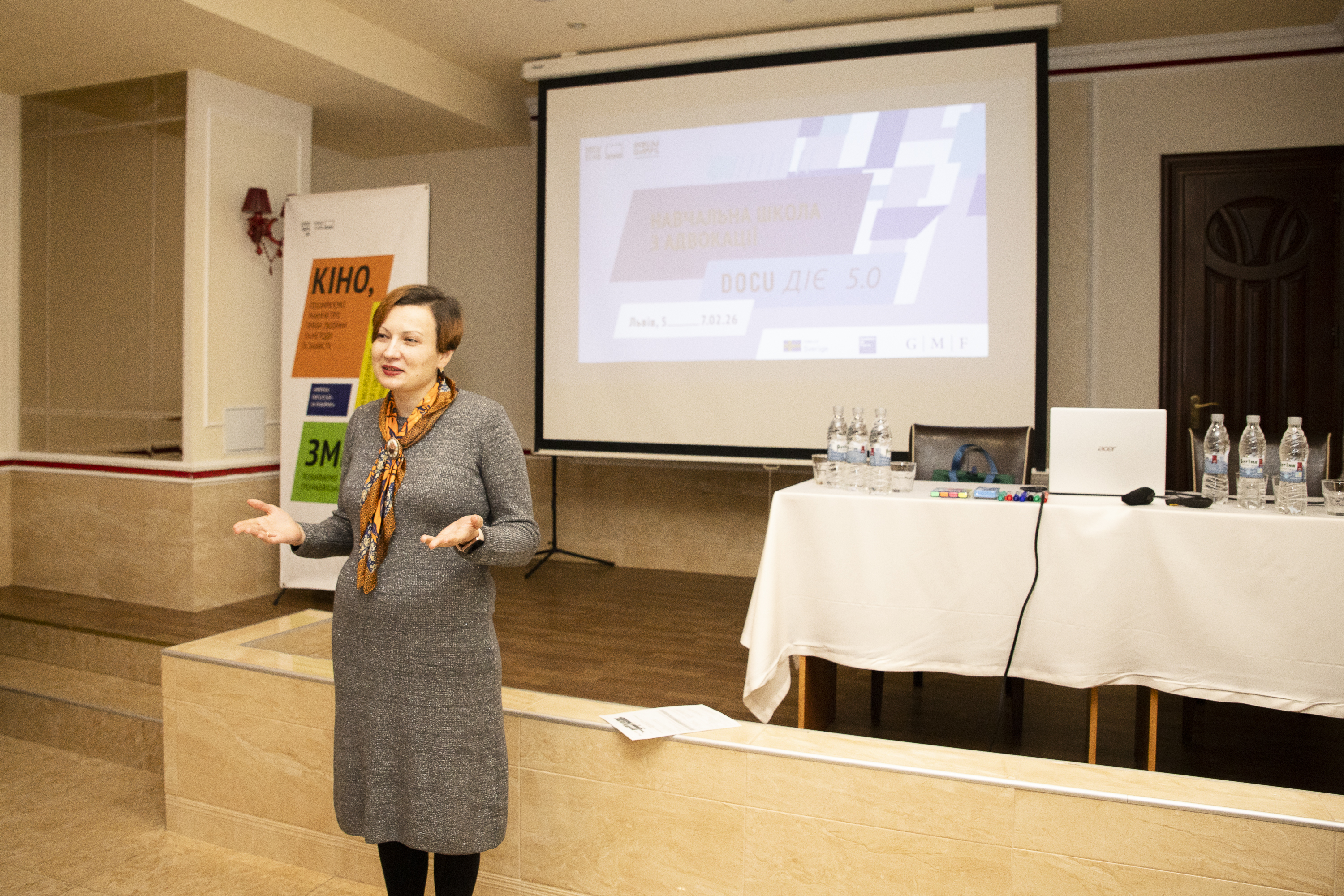
Nina Khoma
For the DOCU/CLUB Network, supporting advocacy projects is part of its strategic development. Nina Khoma, Head of the Network, emphasizes: “Advocacy transforms film clubs into powerful centres of civic engagement. It proves that documentary films have real power, which extends beyond the screen and helps society overcome paternalism. When people see that they can achieve real transformation in their community or ensure transparency in local government decisions, they start to believe in their own capabilities.”
The School's programme was designed as an intensive practical course covering the full cycle of an advocacy campaign. Participants not only listened to lectures, but also, under the guidance of seasoned trainers and facilitators, developed steps for the practical implementation of the acquired knowledge in their advocacy projects.
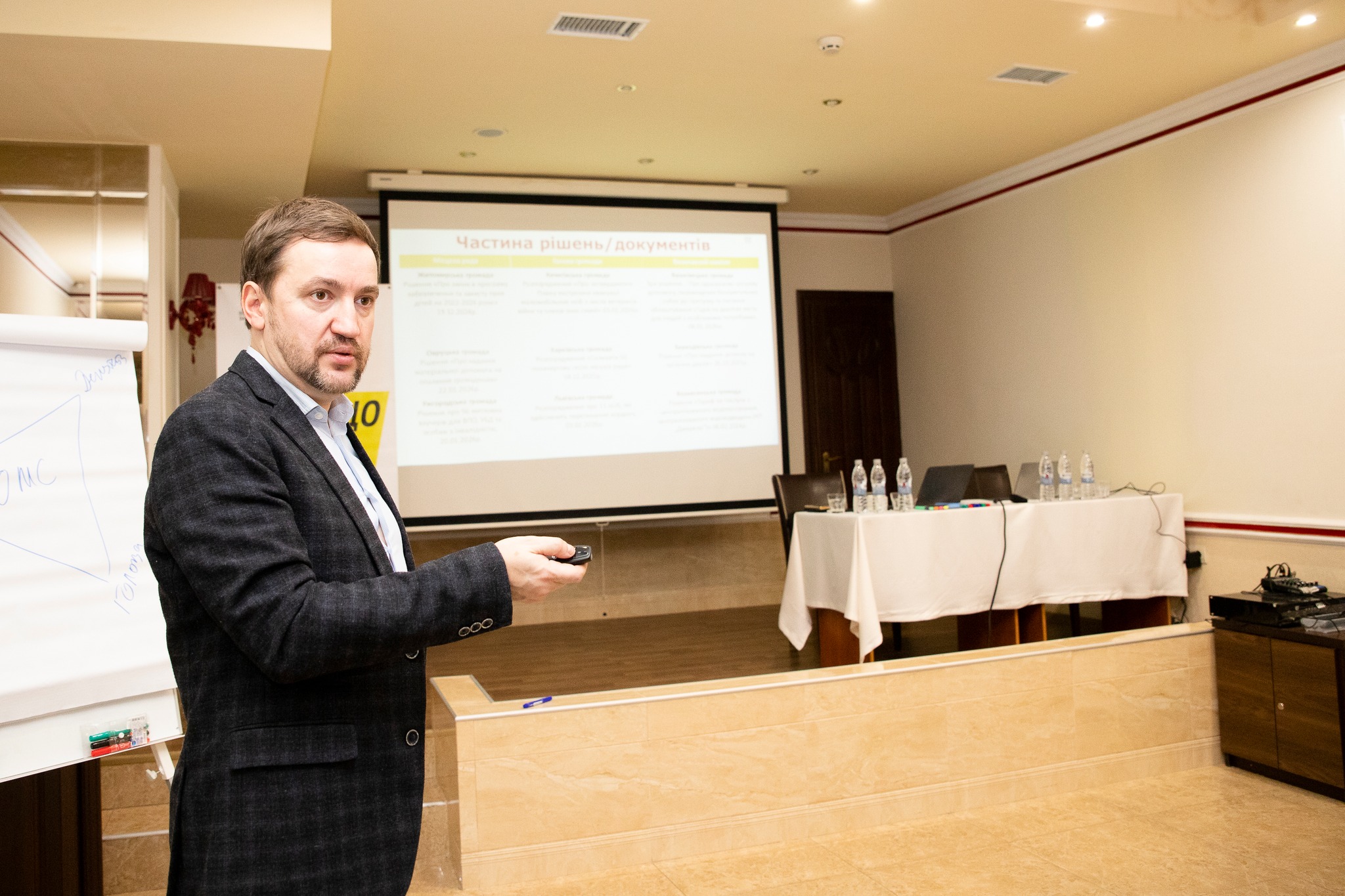
Oleksandr Solontay
The first day of training was dedicated to learning about the mechanisms of local self-government. Oleksandr Solontay, an expert on public participation in local self-government and advocacy, helped participants understand the functioning of all the levels of local authorities.
Moderators studied the responsibilities of local authorities to understand who is in charge of solving a particular problem. Particular attention was dedicated to the process of consultations with the ‘target’ (the decision-maker) at the project development stage. This strategic approach allows not only to demand positive transformations, but also to offer ready-made solutions developed in cooperation with representatives of local self-government.
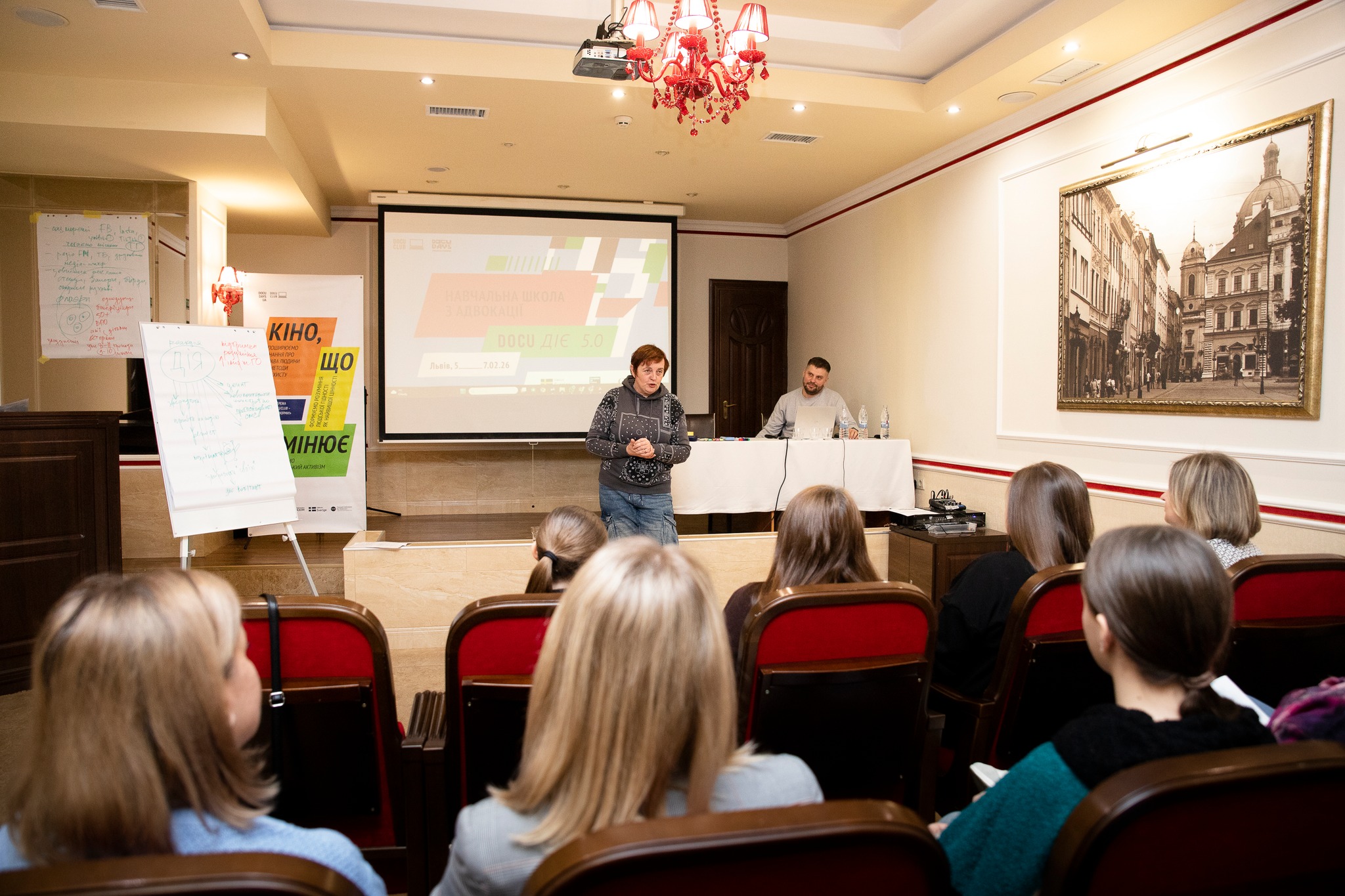
Olena Afanasyeva
The second day of training focused on engaging society and authorities with ideas for change. Olena Afanasyeva, graduate of the Advocacy Institute (USA) and creative director at Urban CAD, shared her experience on how to make advocacy more prominent.
Olena shared the components of an information campaign and creative ‘tricks’ that can transform a seemingly ‘dry’ human rights issue into a lively social trend. With her help, the participants of the School generated ideas for their own advocacy projects that will help moderators gain the support of a broad audience.

Participants are learning to transform advocacy goals into visual content
The DOCU/CLUB Network’s communication team – Tetyana Husar and Olha Babchuk – transferred the training into the realm of modern media. Participants learned to create stories, reels, and short videos that can mobilise the community. Moderators mastered the skill of conveying their advocacy goals in a visual format, which motivates viewers to take action.
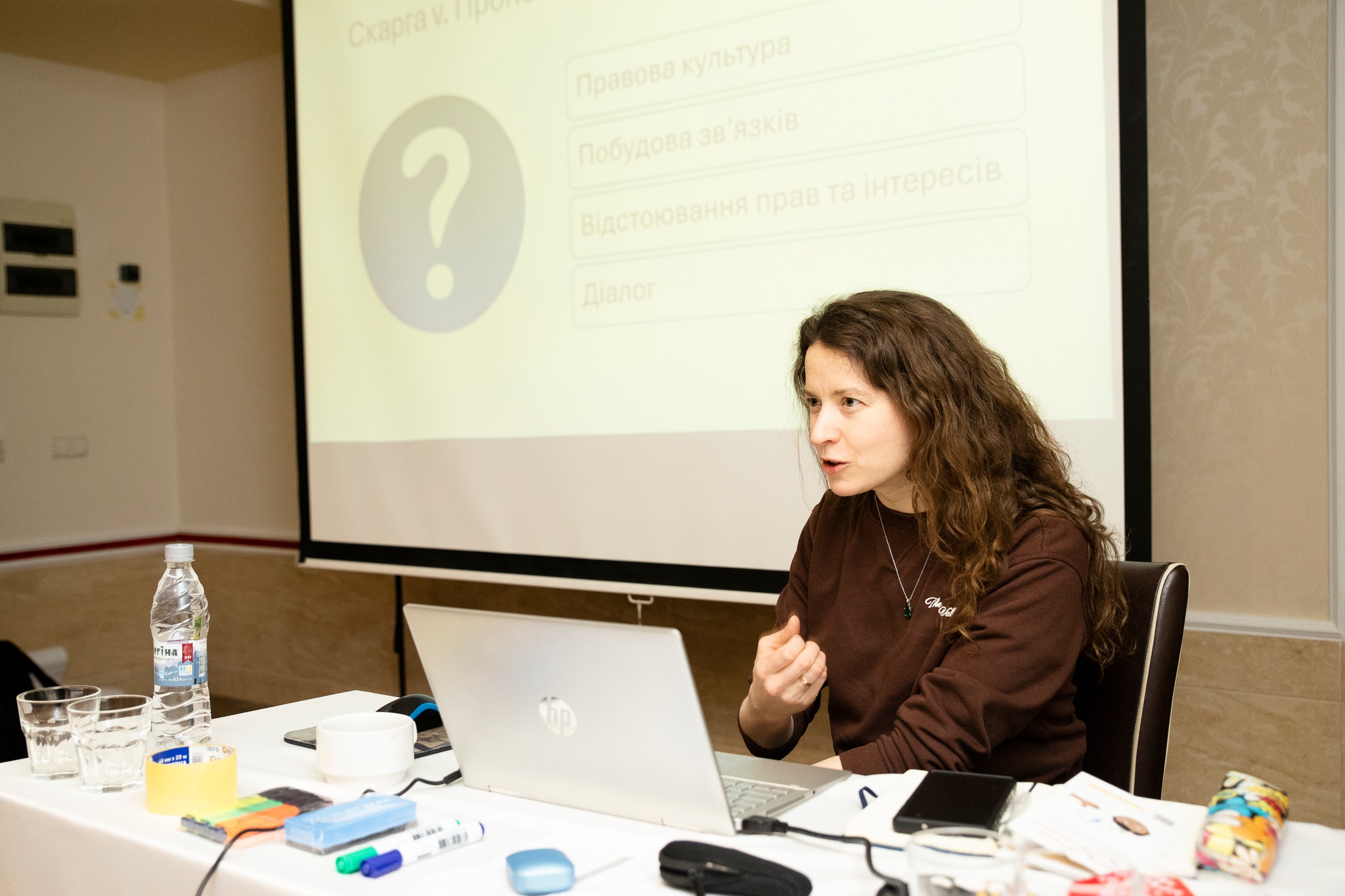
Maria Tsypiashchuk
The last day of training was devoted to the legal aspects of advocacy. Maria Tsypiashchuk, a lawyer and trainer in human rights and international humanitarian law, familiarised participants with algorithms for action in the legal field.
They examined legal instruments for achieving goals, from official requests and appeals to the use of international human rights standards. Moderators learned to determine forms of legal interaction with local authorities that are appropriate and effective within advocacy projects, which will strengthen their position in communication with officials.
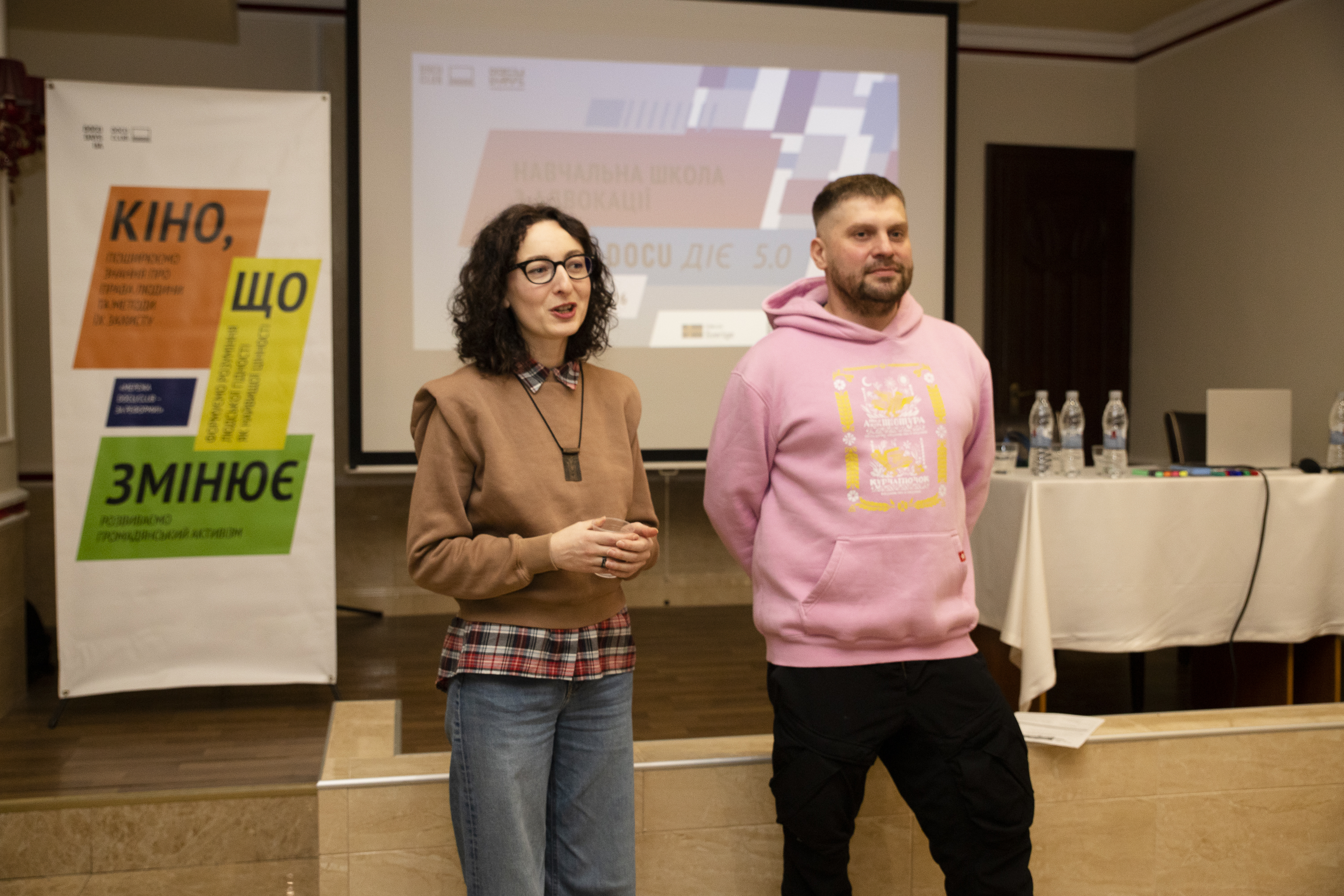
Maria Tyshchuk and Taras Hrytsiuk
Maria Tyshchuk and Taras Hrytsiuk, facilitators of the NGO “Insha Osvita,” created an environment of warmth, trust, and mutual support for the School participants, bringing everyone together through informal activities, team games, and exercises.
“I came up with lots of new ideas and realized what is crucial for successful implementation of my project.” “I was impressed with the level of organization of the School, the highest level of involvement of all participants, and the focus on mutual support and the quality of training.” “The choice of topics for the training sessions was spot on — as if the organisers had read my mind and identified the weaknesses in my project.” “I really liked the practical case studies and group work,” — this is just part of the participants’ feedback.
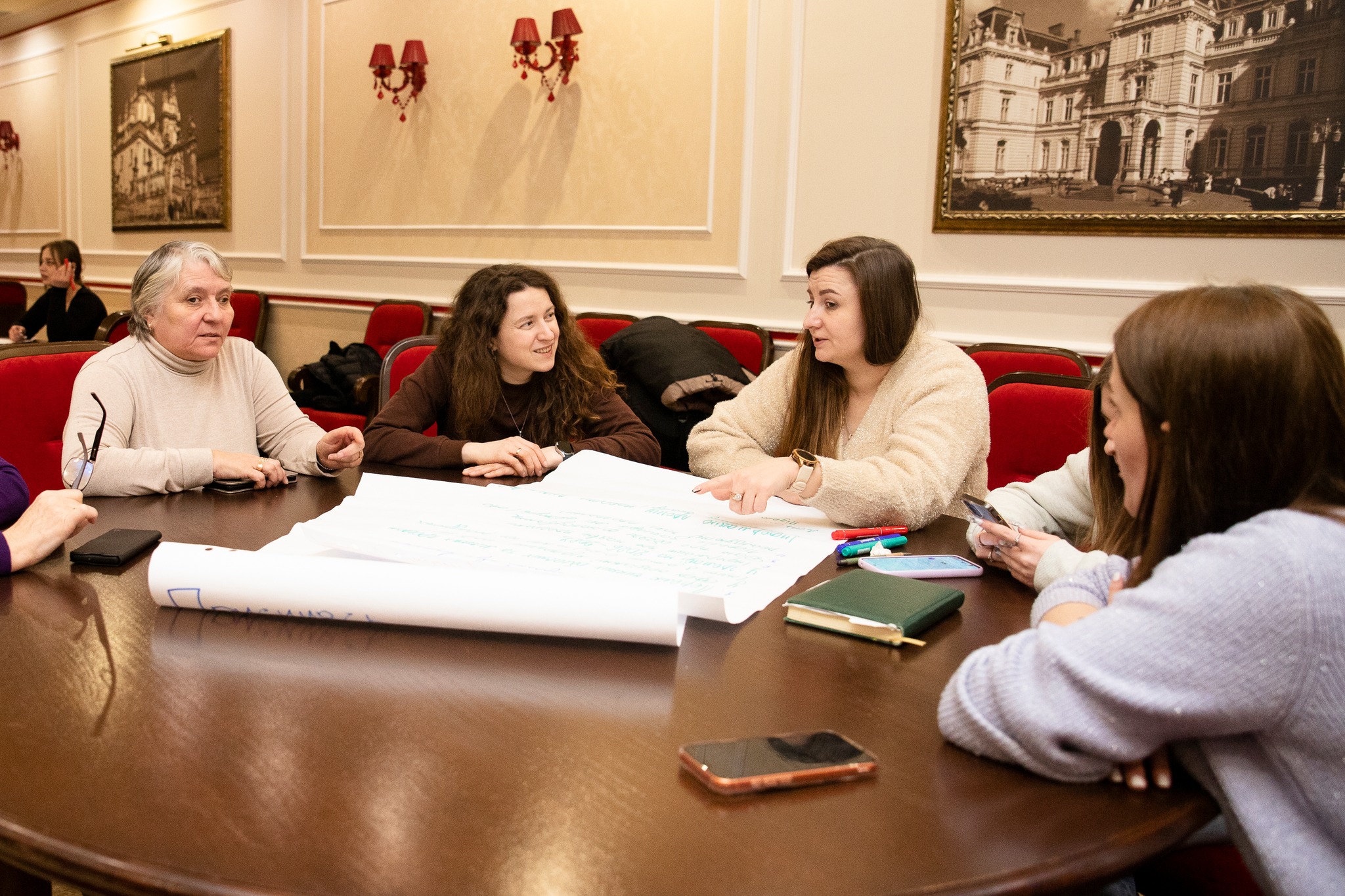
Photo: Practical tasks during training sessions
The advocacy school has proved that film club moderators are potential community leaders. Due to the acquired knowledge, advocacy campaigns are being implemented in cities and villages, reinforced by legal literacy, visual content, and support of local activists.
Nina Khoma is convinced that conducting such schools is important for the development of democratic institutions in the country, because democracy is the citizens’ ability to influence processes day by day. “Successful advocacy projects strengthen the foundations of the state. Democracy only works when there is active control and demand from the community in-between elections. Participants of the Advocacy School become agents of change who make the government accountable and its decisions human-centred,” emphasises the Head of the Network.
The DOCU/CLUB Network continues to convert the power of documentary films into the engine of real change, where every film screening can be the starting point of a great success story for the entire community.
The project is implemented with the support of the DOCU/CLUB Network, funded by the Embassy of Sweden in Ukraine, Fondation de France and the German Marshall Fund of the United States of America.
The opinions, conclusions or recommendations are those of the authors and compilers of this publication and do not necessarily reflect the views of the governments or charitable organizations of these countries. The authors and compilers are solely responsible for the content of this publication. All news