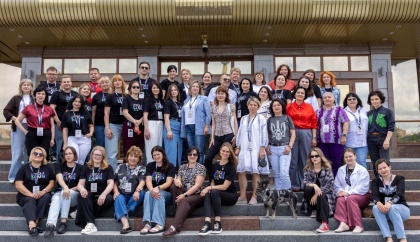
The recent Moderators’ Conference, organized by the DOCU/CLUB Network of film clubs, has become our community’s platform for annual reviews, sharing inspiration, and encouraging meaningful transformations. The scope of the film clubs’ activities over the past year is impressive: the community hosted 2,812 offline, online, and hybrid format events. This means that, on average, 8 screenings and discussions of documentary films took place every day in Ukraine and abroad, bringing together 36,297 viewers. Our Network currently comprises 615 film clubs in 22 countries.
The Network team prepared a review of the best film club practices for the Conference participants. The selection criteria were simple yet profound: every one of these moderators was capable of going beyond film screenings, turning their film clubs into tools of direct action. They’ve demonstrated incomparable flexibility and resilience, working in completely different environments, from cozy lyceums in western Ukraine to near-front-line libraries in the Donetsk region and challenging audiences at correctional facilities.
The experiences of these people show that documentary films help create programs for local development, protect the environment, resocialize convicted persons for normal life, and implement educational innovations. These are premade, successfully tested “recipes for change” that any community can take as the foundation for implementation.
Let us learn more about them.
Film clubs at libraries: Traveling cinemas, environment, and accessibility
Today’s library is more than a repository of books; it has become a vibrant platform for legal education and advocacy.
-
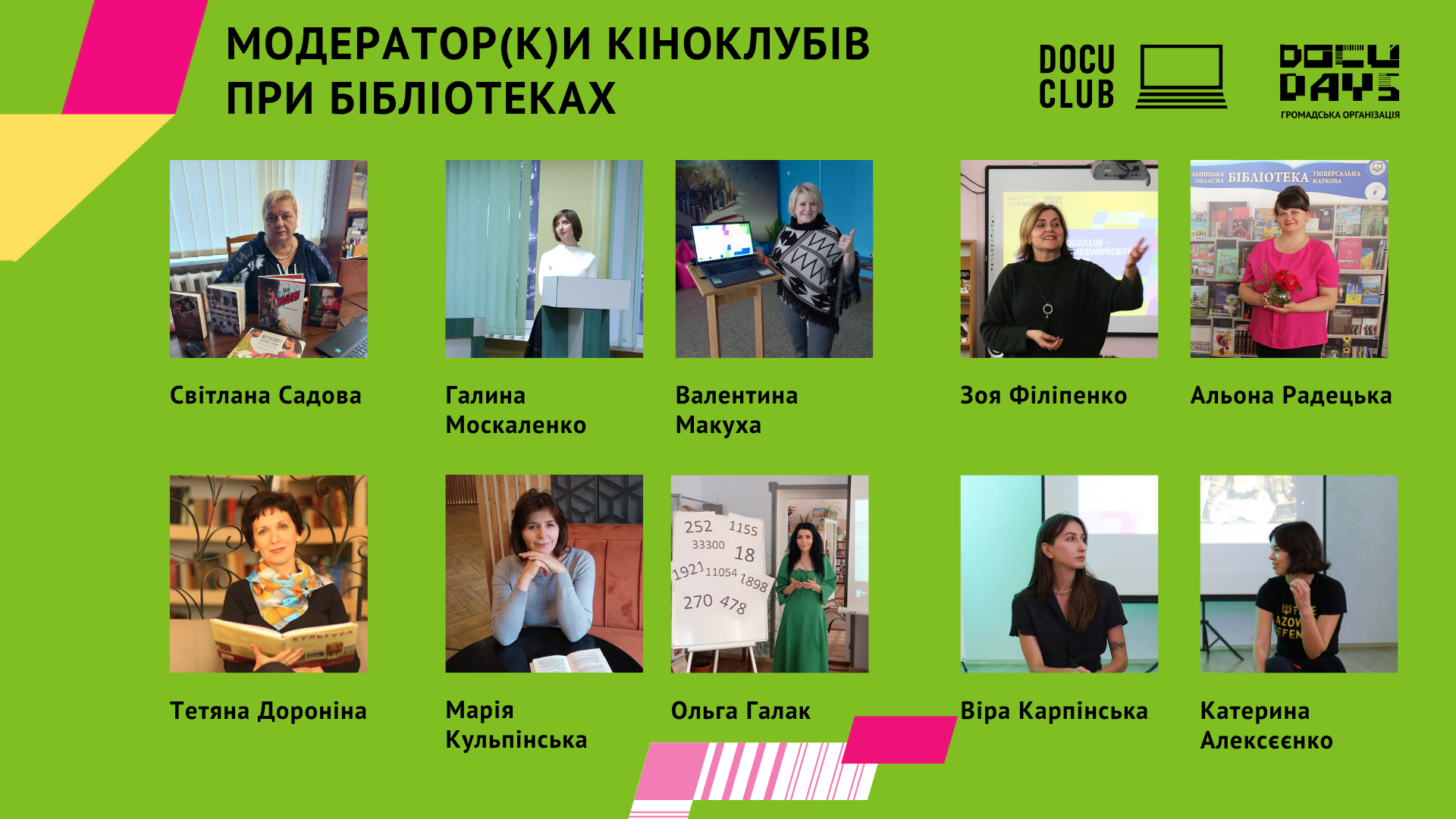
The “Promin” film club at the Central City Library in Shostka opened in 2015. In 2024, its team, led by Anzhelika Penkina, successfully implemented a media literacy advocacy program for local residents and internally displaced persons. Despite today’s security challenges, moderators Halyna Moskalenko and Valentyna Makukha continue their work. “Promin” remains one of the most well–traveled film clubs, as its moderators regularly bring films to remote communities.
-
The “Femida” film club at the library branch in the village of Shabelkivka, near Kramatorsk, Donetsk region, continues to do impressive work. Despite its proximity to the front line, moderator Svitlana Sadova consistently brings people together around cinema, both online and in person. Her work is a living example of resilience and the incredible strength of cultural initiatives in challenging environments.
-
The Docudays UA film club at the Dnipropetrovsk Regional Children’s Library opened in June 2023. Its moderator, Tetyana Doronina, confidently chooses challenging topics for students and schoolchildren, such as war, the Maidan, the Holodomor, the Holocaust, or bullying. Her unique experience of involving internally displaced persons in screenings helps people regain a sense of home and belonging. After the screening of Language by Serhiy Lysenko, the library even organized Ukrainian language courses for the elderly and internally displaced persons.
-
Vira Karpinska and Kateryna Alekseyenko, moderators of the Docudays UA film club at the Lviv Municipal Library, have a unique experience working on inclusivity and organizing inclusive screenings. They have implemented two important advocacy projects: “Information accessibility for people with blindness and visual impairments” and “Integrating minor subjects of probation into socio-cultural life of the community.” Their cooperation with adolescents on probation continues actively.
-
Environmental initiatives in the Khmelnytskyi region. Zoya Filipenko and Alyona Radetska, moderators of the Docudays UA film club at the Khmelnytskyi Regional Scientific Library, have long been actively engaged in environmental issues. Zoya Filipenko participated in the first DOCU ACTS program and advocated for solutions to the waste sorting in the community. Both moderators seek unconventional approaches: for instance, they invited internally displaced persons who once worked at the Askania Nature Reserve for the screening of Askania Reserve by Andriy Lytvynenko. In 2024, their colleagues Maria Kulpinska and Olha Halak, moderators of the Docudays UA film club at the Chemerovets Central Library, implemented a large-scale environmental advocacy campaign. Through their work with local residents and a community survey, an active environmental community has formed, and the village council has officially approved the Program of Environmental Protection Measures they developed.
Film clubs at NGOs: From cleaning of rivers to creation of new jobs
For the civil society sector, a film club is a direct action tool that helps engage locals in activism and government oversight.
-
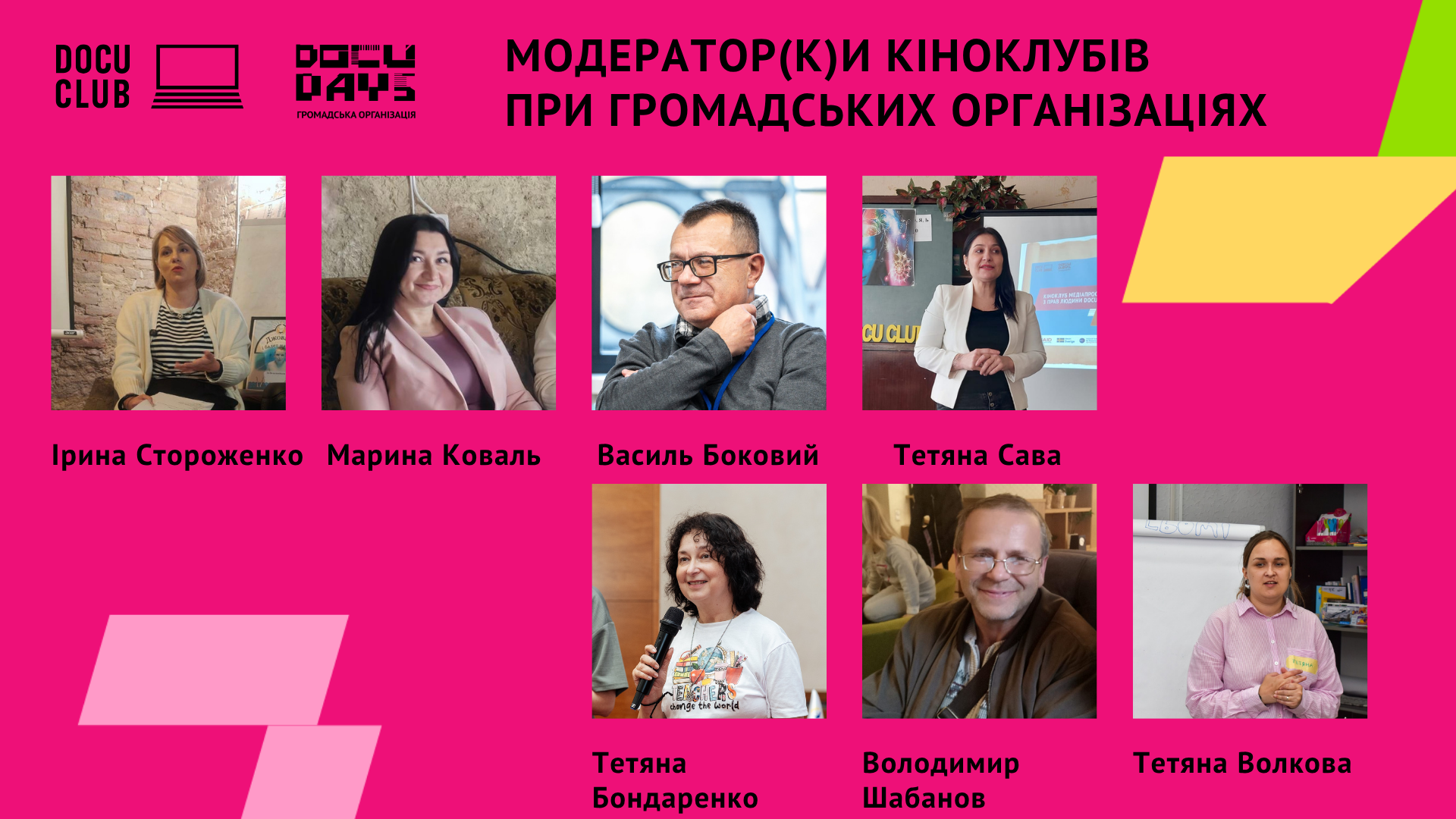
Docudays UA film club at the Community Foundation “Bari” in Vinnytsia region was created as recently as January 2026; however, its moderators, Iryna Storozhenko and Maryna Koval, have already organized 10 screenings. In their unique practice, they accompany almost every screening with meetings with filmmakers, their protagonists, or specialists, which makes post-screening discussions really profound.
-
The “Forum” film club at the NGO “Priority” from Oleksandrivka in the Kirovohrad region has been active in the Network since 2022. In 2024, its moderators, Tetyana Bondarenko and Volodymyr Shabanov, aimed their advocacy campaign at the issue of employment for IDPs. The outcome was a victory for the community: the Oleksandrivka village council adopted a resolution prioritizing the involvement of internally displaced persons in paid community work and made corresponding amendments to the Comprehensive Program for Supporting IDPs.
-
The Docudays UA film club at the NGO “Uspishna Vzayemodiya” in Kompaniyivka, Kirovohrad region, has been extremely active. Its moderators, Vasyl Bokovyi and Olena Mirkhaydarova, engage the residents in discussions of the themes of government oversight and civic participation. They bring human rights issues to the forefront at the community level by visiting schools, colleges, and libraries, and by systematically working with cadets at the Police Academy, which was relocated from Mariupol.
-
Tetyana Volkova, moderator of the “Poza prokatom” film club at the NGO “Medialab” in Pavlohrad, Dnipropetrovsk region, successfully combines the power of journalism with films. In 2024, her advocacy project rallied the Pavlohrad community around the effort to save local water bodies. Through joint efforts, residents cleared the banks of the Vovcha River and carried out its biological restoration, and their proposals were officially incorporated into the city’s Environmental Protection Program for 2025–2027.
-
Tetyana Sava, moderator of the Docudays UA film club at the NGO “Power in Unity” from Novoukrayinka, Kirovohrad region, has conducted 100 screenings for children and teenagers since 2020. Her experience proves that documentaries inspire action: after watching The Tales of a Toy Horse, the children created their own book of stories, and after another screening, they initiated and installed an open-air screening venue.
Film clubs at museums and communities: Life after destruction and connections between generations
The DOCU/CLUB Network’s film clubs based at museums and local communities demonstrate how documentary film heals and unites communities during the most difficult times.
-
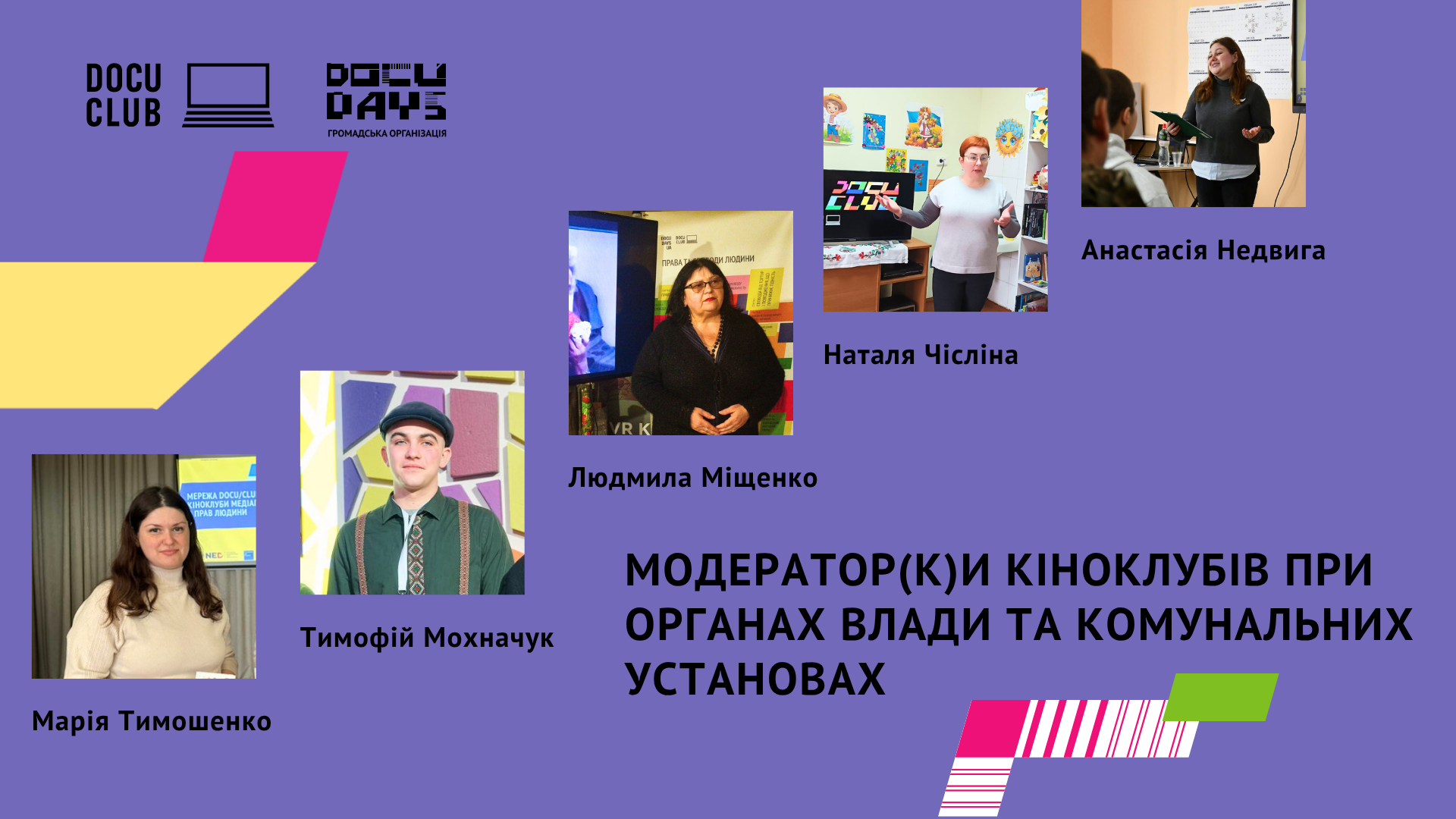
Maria Tymoshenko, director of the “Turbota” Day Care Center in Kremenchuk, Poltava region, and head of the film club, works with women who have been victims of domestic violence. She also conducts important training sessions for schoolchildren and regularly participates as an expert at screenings at the film club affiliated with the Kremenchuk Correctional Facility, supporting the work of her colleague, moderator Olena Udovytska.
-
The moderators of the film club at the Zdolbuniv Local History Museum, Dmytro Chyzhevskyi and Tymofiy Mokhnachuk, successfully engage schoolchildren in museum life, giving them the opportunity to discuss topics in an informal atmosphere. Since the museum itself once grew out of a volunteer community, the film club continues to actively foster a powerful team of “friends of the museum.”
-
Lyudmyla Mishchenko, moderator of the “DOCUПАНОРАМА” film club at the Okhtyrka City Local History Museum, made the bold decision to launch the film club after Russian invaders completely destroyed the museum building. Despite operating amid the ruins, the film club is creating remarkable stories of change: after watching the film Cutting Loose by directors Finlay Pretzell and Adrian McDowell, one of the probation clients enrolled in a vocational high school to train as a hairstylist and fashion designer. And after watching Askania Reserve, museum staff and volunteers cleaned up the banks of the Okhtyrka River, restored a natural spring, and planted an oak-lined avenue in the city park. For every screening, the museum team prepares a themed exhibition based on its collections, showcasing cross-platform cooperation.
-
Natalya Chislina, moderator of the Docudays UA film club at the Chopovychi village council in Zhytomyr region, has conducted a screening of Shepherd Boy in the remote village of Lypliany, with only 89 inhabitants. The event brought together representatives of three generations—children, parents, and village elders. The emotional discussion that sparked between all of them inspired the residents so much that they decided to establish a permanent film club, named “Interaction between Generations.”
-
The Docudays UA film club at the communal enterprise “Puzzle” Youth Center in the village of Voynivka, Kirovohrad region, has joined the Network only recently; however, its moderator, Anastasiya Nedvyha, already organizes monthly screenings for young people, creating a space for discussions about human rights. Anastasiya hosts unique inclusive screenings that bring together community members, school leaders, and veterans. She also actively promotes the film club movement on Instagram.
Film clubs at probation institutions: Documentaries that give a second chance
Working with people in conflict with the law is one of the most challenging spheres of work, where documentary films serve as an effective tool for the resocialization of convicts and for helping them rethink their life paths.
-
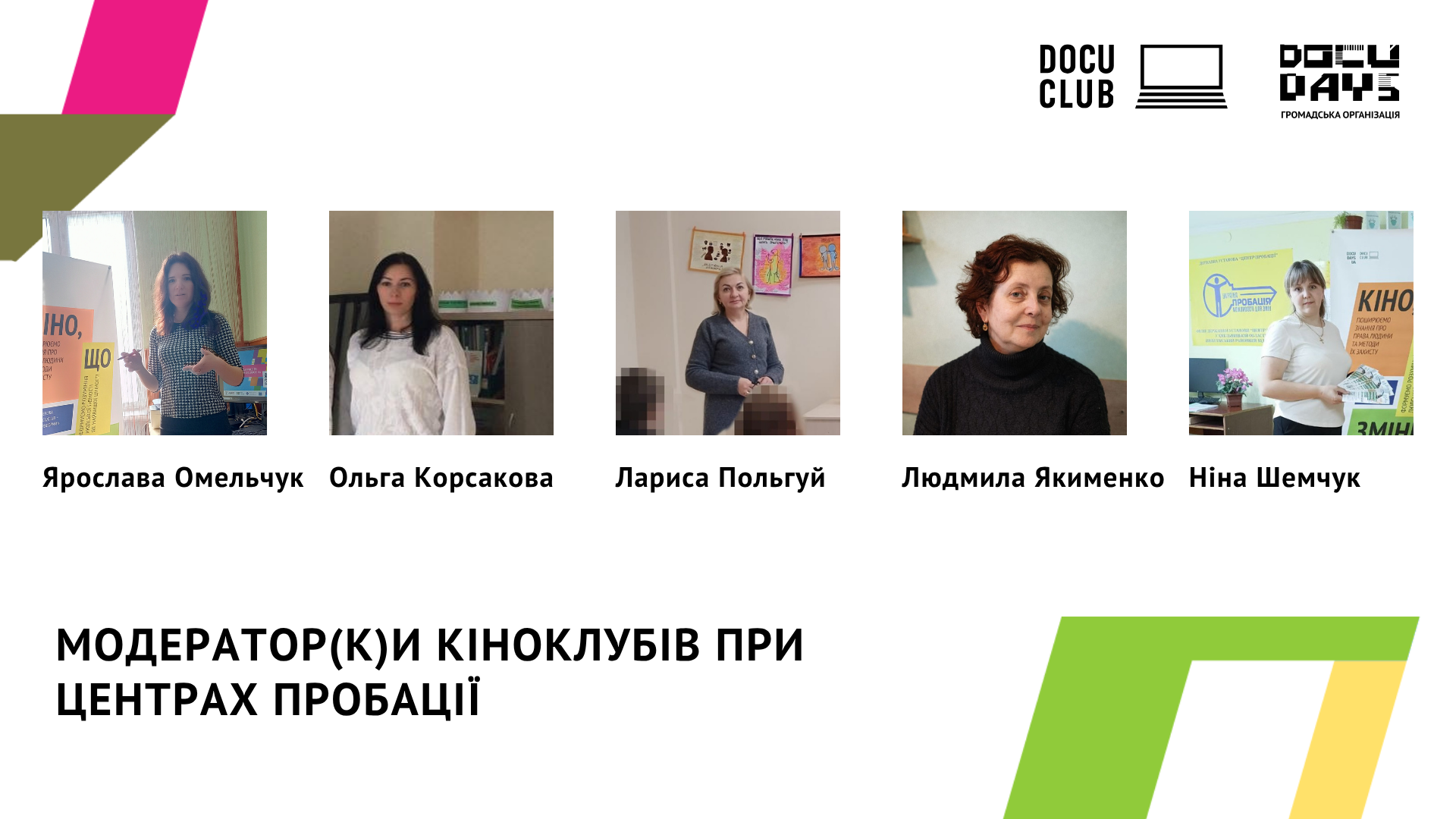
The Docudays UA film club at the Korosten District Office No. 1 of the Probation Center’s Zhytomyr branch has been operating since 2023. Its moderator, Yaroslava Omelchuk, regularly engages experts to discuss human rights and resocialization of probation clients. Yaroslava is an active contributor to local community websites, where her articles about the film club’s events receive 500–600 views each, helping to convey important messages to a broad audience.
-
Olha Korsakova, moderator of the Docudays UA film club at the Zhytomyr Juvenile Probation Sector, specializes in working with minors. She is extremely meticulous in selecting films and experts, helping teenagers reflect on their actions and find support. Olha has established excellent relations with the Zhytomyr City Council’s Children’s Services Department, successfully coordinating the film club’s efforts with the city.
-
Larysa Polguy, moderator of the Docudays UA film club at the Mykolaiv Juvenile Probation Center, actively uses documentaries in her work with adolescents and never avoids difficult and painful topics (for instance, she organized screenings of Intercepted by Oksana Karpovych and Between the Walls: The Story of Aaron Weiss by Zvika Nevo). These screenings help her speak candidly with young people about responsibility and life choices, and work on preventing repeat offenses.
-
Liudmyla Yakymenko, moderator of the Docudays UA film club at the Izmail District Department No. 2 of the State Institution “Probation Center” in the Odesa region, has often witnessed the transformative power of documentary film. She shared a striking story about her work with a young man convicted of collaboration. It was precisely watching documentaries about Euromaidan that helped him completely rethink his own actions, open up to an honest dialogue with society, and eventually become an active volunteer at a local volunteer center. Liudmyla Yakymenko actively goes beyond the scope of her work with probation clients; she conducts discussions of documentary films at volunteer and civic organizations, as well as at local educational establishments.
All these stories, presented at the Moderators’ Conference in Kyiv, demonstrate that the DOCU/CLUB Network is a unique ecosystem that has transformed documentary film into a “soft power” capable of uniting communities and addressing serious social, environmental, and legal challenges.
The experience of film club moderators is invaluable, as each has created a ready-made, proven model for change that any other Ukrainian community can adopt.
The project is implemented with the support of the DOCU/CLUB Network, funded by the Embassy of Sweden in Ukraine, Fondation de France, and the German Marshall Fund of the United States of America.
The opinions, conclusions, or recommendations are those of the authors and compilers of this publication and do not necessarily reflect the views of the governments or charitable organizations of these countries. The authors and compilers are solely responsible for the content of this publication.
All news