
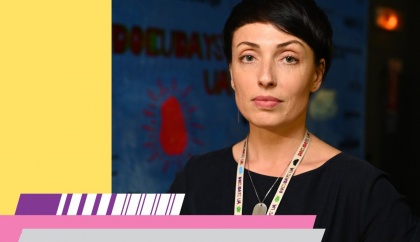
The event became part of a series of educational seminars for film club moderators who seek to deepen their understanding of contemporary Ukrainian documentary filmmaking in order to work with audiences and communities more effectively.
At the beginning of her lecture, Olha Birzul emphasized that, following the Revolution of Dignity, Ukrainian documentary filmmaking went through a genuine creative breakthrough. Films became something more than mere testimonies of events; instead, they have turned into tools for social dialogue, disclosing the issues of solidarity, resilience, identity, and the experience of war.
“Documentary films have become ways of living through collective experience. They help us see not only war itself, but also humanity that emerges despite it — the humanity that gives us the strength to persevere,” noted the lecturer.
A separate part of the lecture was devoted to the differences between television documentaries and non-fiction films. TV documentaries often focus on facts and quick responses to current events, whereas non-fiction cinema allows viewers to engage more deeply with meaning and evokes an emotional response.
“What matters in documentary filmmaking is not only information but also the form. Through the cinematic language, filmmakers reveal the inner world of their protagonists and allow us to see life without commentary, yet filled with emotion,” explained the film scholar.
Moderators also learned how directors create metaphors in documentary films using editing, rhythm, sound, and details from real life. Olha presented several examples from contemporary Ukrainian films and discussed the nuances of cinematic language with the audience through these case studies.
The lecture also focused on the issue of ethics in documentary filmmaking. The speaker discussed the ethical triangle of non-fiction cinema — the director, the protagonist, and the viewer, — emphasizing that every film is an act of trust among these three parties.
“A documentary filmmaker not only has the right to express their own perspective, but also bears the responsibility to respect and preserve the dignity of their protagonists, even when addressing pain and trauma,” emphasized Olha Birzul.
Participants also discussed the dangers of aestheticizing trauma and the spread of misinformation in today’s media space, as well as the role moderators can play in helping audiences responsibly reflect on what they see.
During the practical part of the seminar, participants watched short fragments of documentary films and analyzed their cinematic language, including frame composition, editing, tone, and visual imagery. This exercise not only trained them to observe the way films “communicate” but also to understand how to discuss them with audiences.
Olha Birzul’s lecture reminded moderators that documentary films not merely inform viewers about other people’s challenges and problems — they are a powerful tool for fostering empathy, trust, and social dialogue.
“The DOCU/CLUB Network is a community where documentary films live not only on the screen but also in the conversations and actions of their viewers. Understanding the artistic dimension of non-fiction cinema will deepen audiences’ appreciation of the films,” concluded the lecturer.
The development of the DOCU/CLUB Network is funded by the Embassy of Sweden in Ukraine, the National Endowment for Democracy (NED) and Fondation de France.
The opinions, conclusions or recommendations are those of the authors and compilers of this publication and do not necessarily reflect the views of the governments or charitable organizations of these countries. The authors and compilers are solely responsible for the content of this publication.