Every day, thousands of elderly people all over Ukraine are facing this challenge, which is invisible for outsiders. Moving to new communities due to the war, loss of social connections because of forced migration of younger relatives, the necessity to apply for state subsidies, and communicating with the government institutions via mobile screens only intensify the problem. The need for basic digital literacy has turned from entertainment to a matter of social survival and safety.
Reprinted from BukInfo.
In order to help people overcome this barrier, Maryna Humeniuk, moderator of the Docudays UA media literacy film club and a computer science teacher at the Vashkivtsi school in the Chernivtsi region, initiated the advocacy project “Digital Independence: Navigating Everyday Issues” within her community. Her initiative has grown into a large-scale support program capable of transforming the community’s life.
Maryna Humeniuk’s journey to this project began with a coincidence that would later reshape her teaching practice. “I came across an announcement for a webinar by the DOCU/CLUB Network of film clubs, which was dedicated to sexual abuse against children on the Internet. This really piqued my interest as a homeroom teacher. This is how I was introduced to documentary films about human rights and decided to open a film club at my school,” Maryna recalls.
The potential of documentaries for legal education impressed the teacher. The first year of the Vashkivtsi school film club proved to be highly successful. Schoolchildren enthusiastically participated in screenings of documentary films that address pressing social and legal issues.

Maryna Humeniuk, Docudays UA
When the DOCU/CLUB Network announced a competition to support advocacy projects in communities, Maryna Humeniuk realized her film club could be useful not only to students. As a community activist, she noticed that not only children, but also adults, especially the elderly, require the skills to safely and confidently navigate the digital space.
For this demographic, a smartphone often becomes the only bridge to distant relatives or a lost home. However, using it can be tricky. Lack of understanding of mobile app interfaces, fear of online banking, inability to use government portals, and overall vulnerability to online scams — these challenges isolate older people from active social life.
The Docudays UA film club became the platform that helped address these challenging issues in a gentle, relaxed way, without academic pressure. Documentary films about Internet safety, cyberbullying, and fraud helped the audience understand the key point: access to information and technology is their fundamental right, and digital safety is the cornerstone of personal freedom.
The advocacy project “Digital Independence: Navigating Everyday Issues” proved to be vital for the Vashkivtsi community. The film club started hosting practical workshops on media literacy and navigating everyday digital issues.
Having gained basic knowledge, older adults felt more confident and independent: they are learning to make doctor’s appointments, pay their bills, and check news for misinformation without external help. In addition, the project actively involves local youth as volunteer mentors, which creates a unique space for intergenerational dialogue and unity within the community.
Maryna Humeniuk says that active participation in these initiatives helps local teenagers feel useful: “We call them ‘digital navigators.’ High-schoolers are eager to become mentors for their older relatives. This learning process is mutually beneficial for both generations. Older people take pride in seeing their grandchildren serve as mentors to others, which is wonderful to behold! For the youths, participating in the project became their first experience of involvement in active community life. I’m confident that it will inspire them to take on future projects and initiatives.”
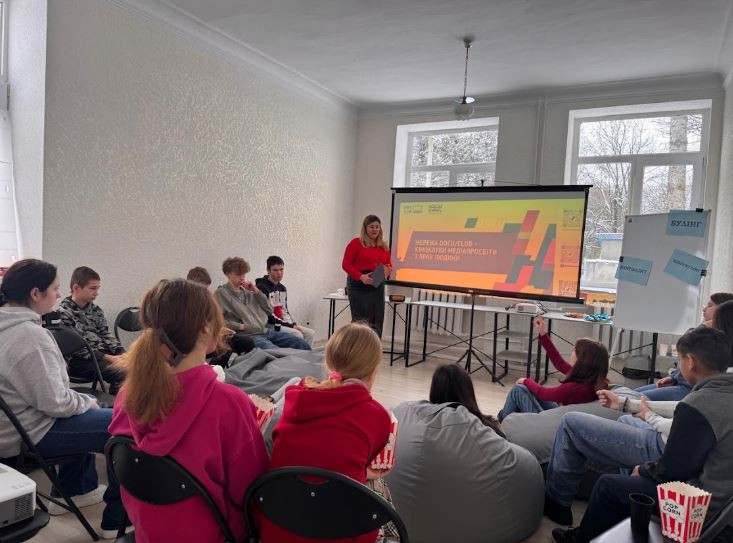
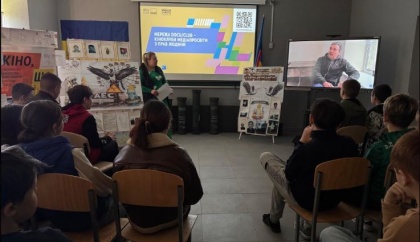
Photo from a film club screening
However, the project coordinator realized that, in order for the initiative not to lose momentum after the end of the advocacy campaign, its results have to be formalized. Thus, the advocacy project team worked thoroughly with local authorities, which resulted in a strategic decision to amend the Vashkivtsi Council’s Comprehensive Social Protection Program for 2025-2029.
Another important step was the active involvement of the local Social Services Center in implementing this program. This institution’s contribution will ensure the continuity of the program, as social workers will now be able to systematically guide and support their clients in their digital learning process. The amendments to the Comprehensive Program mean that, from this point, supporting the digital independence of vulnerable groups is not merely a volunteer initiative of the film club, but an officially recognized and supported component of the community’s social policy.
The story from Vashkivtsi demonstrates that major changes don’t necessarily require huge budgets or the involvement of foreign experts. The Vashkivtsi community managed to build an effective, simple, and very human-centered model for bridging the digital divide using internal resources: school computer labs, the expertise of an enthusiastic teacher, and the legal education tools of the Docudays UA documentary film club.
This experience not only helped teach people how to use smartphones but also served as an excellent way to gently integrate them into a more active social life within the community. Step by step, the Vashkivtsi community is overcoming the digital barrier, proving that technology should not divide generations, but unite them for the sake of everyone’s security.
Maryna Humeniuk emphasizes that the results of her advocacy project, “Digital Independence: Navigating Everyday Issues,” open up great prospects for other communities in the Chernivtsi region as well: “I hope that our ideas and best practices will be applied beyond Vashkivtsi. Any other community can adopt our experience, make relevant changes to its own social protection programs, and protect its older residents from digital threats.”
Photo from Maryna Humeniuk’s archive
The project is implemented with the support of the DOCU/CLUB Network, funded by the Embassy of Sweden in Ukraine, Fondation de France, and the German Marshall Fund of the United States of America.
The opinions, conclusions, or recommendations are those of the authors and compilers of this publication and do not necessarily reflect the views of the governments or charitable organizations of these countries. The authors and compilers are solely responsible for the content of this publication.
All news