The DOCU/CLUB Network has conducted traditional legal awareness events dedicated to Safer Internet Day, aimed at informing viewers about the risks awaiting them on the Internet and the ways to counter those risks. The events sparked audience’s interest, because the Docudays UA film club format helps turn ‘dry’ theory into lively discussions: the viewers see real people’s stories on the screen, put themselves in others’ shoes, and look for algorithms of protection in cooperation with experts.
Let us share how the screenings and discussions went.
Swatted by Ismael Joffroy Chandoutis, which tells about swatting and its dangers, became the theme for discussion at many Docudays UA film clubs.
Tetyana Volkova, moderator of the “Poza prokatom” film club in Pavlohrad, Dnipropetrovsk region, focused on the importance of parental control. Olena Kochanova, psychologist and civic activist, emphasized: “‘One should be as careful as possible and make sure that personal information does not fall into the hands of third parties; however, in today’s world, parents have to be prepared for any scenario.”
During the discussion, Lina Chernykh, one of the viewers of the film, said, “This is an awesome cool film. It made me think about leaks of personal data through computer games. I have a son who has started playing games, and now I need to discuss safety with him.”
An interesting discussion took place at the ‘Forum’ film club at the NGO ‘Priority’ in Oleksandrivka, Kirovohrad region. Moderator Tetyana Bondarenko proved that even a power blackout cannot stop an important conversation with the youths.
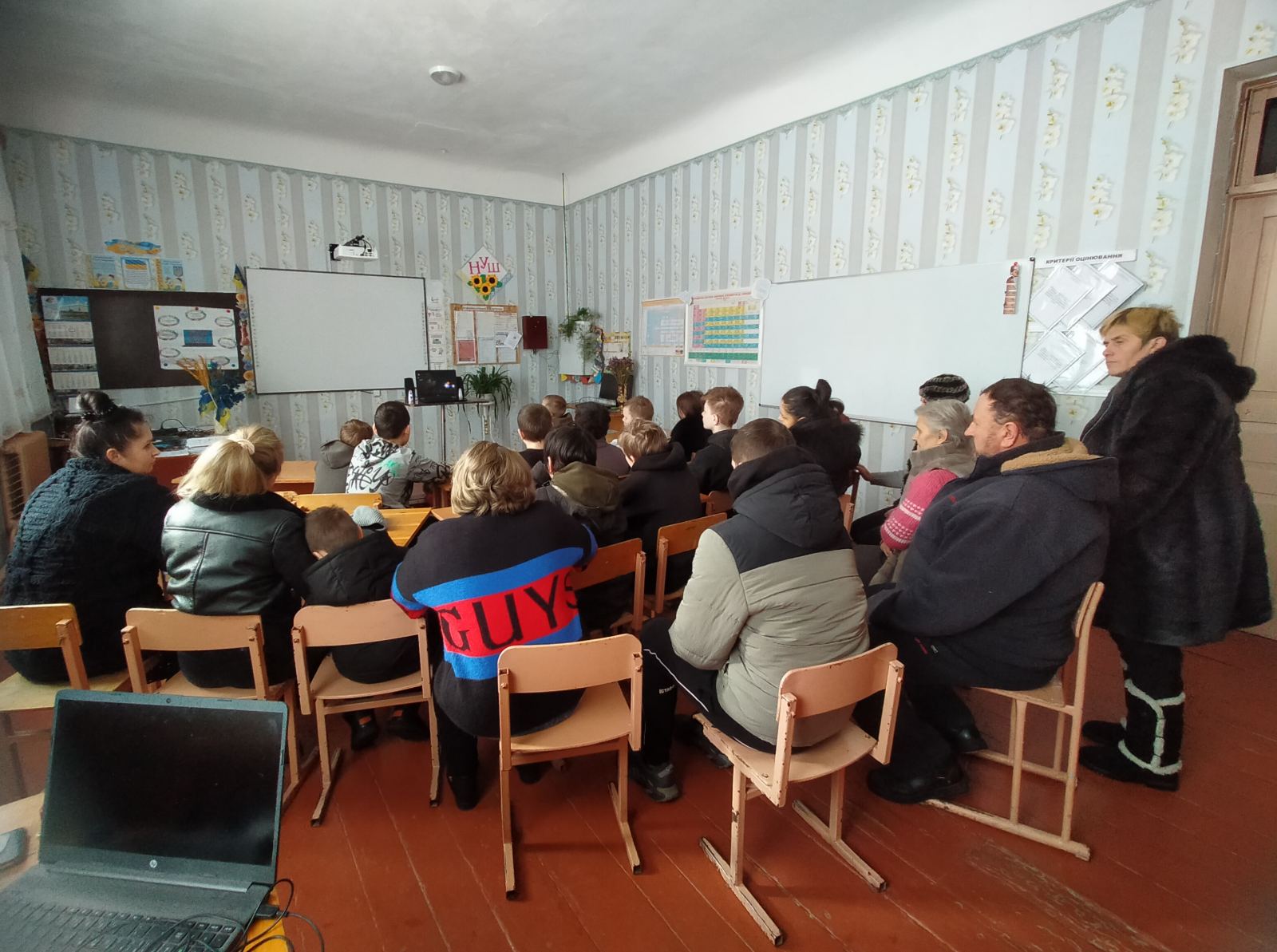
Photo from the meeting of the Docudays UA ‘Forum’ film club at the NGO ‘Priority,’ Oleksandrivka, Kirovohrad region.
Tetyana Poryadko, computer science teacher who attended the event, noted: “Despite the challenging conditions and power outages, we held the meeting to the highest standard possible. The children were very responsive to the theme of this film – they were genuinely surprised that a ‘joke’ on the Internet could have such serious consequences. They’ve been working actively and thinking critically... It is important to me that they did not just watch the film, but also gained practical skills of protecting their accounts and responding to suspicious messages. The children see real-life examples in the film and try them for themselves. It works!”
Children confirmed their teacher’s words: “I liked it because it wasn't boring. I realised that you can't trust everything on the Internet. And now I'm definitely going to change my password.” (Iryna, 5th grade). “I used to think that pranks were just jokes. Now I see that they can be very dangerous.” (Maksym, 6th grade). “It was interesting and serious at the same time. I liked that they talked to us like adults. In wartime, information security is really important” (Artem, 8th grade).
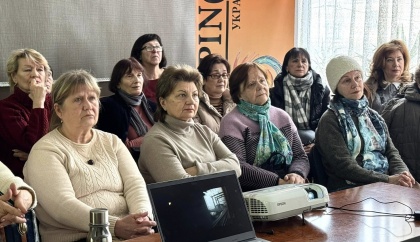
In Zhytomyr, Viktoria Khromova, moderator of the Docudays UA film club at the NGO ‘Ginger’ Center for Youth Initiatives, gathered an audience whose emotions fluctuated between fear and realization of responsibility.
Mrs. Zhanna, former educator, shared: “I keep in touch with my former students, we communicate a lot on social media, and my granddaughter plays video shooters with many of them. After watching the film, I became really preoccupied. I had no idea that, firstly, one could ‘joke’ like that, and secondly, that so much personal information is publicly available!” Monika, a 14-year-old student at the school, added: “The film really impressed and, to be honest, scared me. It made me wonder how much all of us depend on the Internet... I felt helpless because so much information has already been collected about me, and what can you do if your data has already been leaked online? From now on, I’ll think twice about the information I publish.”
Erasing David: digital footprints and surveillance
Erasing David, directed by David Bond, traditionally helps discuss with the film club viewers the theme of total digital surveillance.
Maria Symkovych, moderator of the ‘Alternatyva’ Film Club at the NGO “‘Vested’ Carpathian Human Rights Agency,’” organized a screening and discussion of this film upon request from the Uzhhorod Third Age University. University students were interested in the topic of Internet safety because they attend digital literacy classes.
During the discussion, they shared their own alarming experiences. “I recently witnessed a case of manipulation. One of our students posted on the Internet a very nice photo of herself with a glass of wine next to a Christmas tree. Shortly afterwards, I saw this photo on a third-party website. Her photo was used without permission,” said one viewer. Another added, “I noticed that my phone was eavesdropping on me: everything I talk about is then shown to me as an advertisement on Facebook.” Tetyana Ignatio emphasised: “The development of the digital society means that our gadgets are used to study our image, our thoughts, and predict our future actions, and all of this can influence us. All gadgets have a surveillance system. If data leakage occurs, you should immediately contact the cyber police.”

Photo: Still from the film Erasing David
Moderator Maria Symkovych believes that the theme of discussion, audience profile, and the film itself all fell together: “Older people are the least familiar with the intricacies of the digital world. They found the information about Internet safety particularly interesting. The film made them reflect on many things. The participants expressed their sincere gratitude to the Network’s team for the relevant films and invited them to visit more often.”
Oleksandr Chyzhevskyi, moderator of the ‘Don't Blink’ Film Club at the Zdolbuniv Local History Museum in Rivne region, expanded the discussion of the film with his viewers.
"Today, we are talking not only about ‘eavesdropping ads,’ but also about the fact that our personal data and digital footprints can be used by the enemy to identify people by their affiliation with organisations, their circle of contacts, and their activity. At the beginning of the full-scale invasion, these things had tragic consequences in some communities, particularly in Bucha and Irpin.
After such an experience, it is no longer possible to regard digital security as an additional option of modernity, because it is part of basic hygiene and care for oneself and the others,” said Oleksandr.
The audience actively joined the discussion: “I thought it would be about ‘cybersecurity,’ but it turned out to be very personal. After Erasing David, I really wanted to go and check what services know about me and turn off the unnecessary stuff. It's a little scary, to be honest” (Oleksiy). “I came for the company, but left with a lot of thoughts. Especially about how easily data is collected through government databases and private companies, and how difficult it is to control it all afterwards. It felt like watching a thriller, even though it's a documentary” (Daria). “After watching the film, you really want to be more careful about what you publish and who has access to it. The film is hugely relevant in the context of the war. It's hard to even imagine how much the enemy can find out about our people, our country, our businesses, and our energy sector. These are the two sides of digitalisation…” (Alla).
Caught in the Net: A difficult conversation about sexual abuse on the Internet
In Zaporizhzhia, Larysa Holovko, moderator of the ‘Doloni’ film club at the NGO “‘Doloni’ Communications Center,” organized a screening of Caught in the Net by Barbora Chalupová and Vit Klusak for students of the local college. This film explores the topic of online sexual exploitation of teenagers.
The students’ reaction to the film was instant and emotional: “It was difficult for me to observe the events unfolding in the film. It's disgusting…” (Vladyslav T.). “It was embarrassing and very unpleasant. No one has the right to sexually abuse teenagers” (Karolina).
Psychologist and sexologist Hanna Klymenko analysed the mechanics of the crime in detail: “Online abuse rarely starts with aggression. Most often, it begins with trust. The perpetrator gradually becomes closer to the teenager, creating a sense of a special connection.”
Moderator Larysa Holovko urged young people to report such crimes and reminded them that, according to statistics, Ukraine is among the countries with high levels of online abuse, so knowing what to do (e.g. preserving evidence, blocking content, and seeking adults’ help) is vitally important.
Screenings at film clubs for the Safer Internet Day proved that cybersecurity begins with critical thinking and personal responsibility. Summing up the meeting with the viewers, moderator Oleksandr Chyzhevskyi emphasised: “After the screening, I felt that we’d had a much-needed conversation about today’s reality. The most valuable thing was to see that people were not ashamed to admit their own carelessness, asked questions, and agreed to make simple changes in their habits.” As the participants of the screening in Zhytomyr noted, “what happens online happens for real”; therefore, our protection begins with awareness of the value of our own data.
The project is implemented with the support of the DOCU/CLUB Network, funded by the Embassy of Sweden in Ukraine and Fondation de France.
The opinions, conclusions or recommendations are those of the authors and compilers of this publication and do not necessarily reflect the views of the governments or charitable organizations of these countries. The authors and compilers are solely responsible for the content of this publication.
All news