
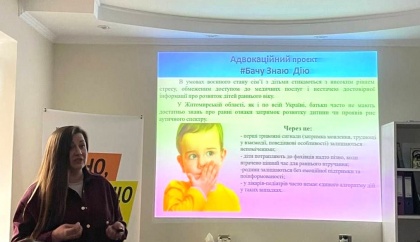
From 2024 to 2026, the number of registered cases of children with autistic spectrum disorders in the Zhytomyr region increased by more than 13 times, from 34 children in 2014 to more than 600 children with such disorders registered nowadays. To ensure early diagnosis of these conditions and raise awareness among doctors and parents, the project “I See. I Know. I Act” was implemented in Zhytomyr.
Reprinted from Suspilne.Zhytomyr.
Natalia Kulinich, editor of the “Ukrainian radio Zhytomyr”, discussed the challenges faced by parents of children with developmental disabilities and the ways to help address them with Tetyana Shevchenko, Deputy Director of the Zhytomyr City Center for Medical Rehabilitation and Palliative Care for Children; Maria Tyshchuk, Head of the advocacy project “I See. I Know. I Act” and mother of a child with developmental disability; and Nadiya Tsyklauri, mother of a child with autism and the founder of the community of parents of children with autism in Zhytomyr.
How did this project come about? What is its purpose?
Maria Tyshchuk: As the mom of an 8-year-old Dmytryk who has autism, I have noticed that the number of children with delayed psycholinguistic development is on the rise. The first warning signs, such as delayed speech and difficulties with communication or interaction, typically appear early and should be identified by pediatricians. However, both parents and doctors share certain myths, for instance, that boys start talking later, or that someone’s son started talking around the age of six, so all you have to do is wait. Time is crucial, though.
If there are even the slightest suspicions, parents should be referred to specialists, so that the child can become part of all necessary intervention programs as soon as possible. This will not only help acquire some knowledge, skills, and abilities now, but also ensure that our children will have fewer disabilities in the future. Subsequently, the children will be able to study and visit various institutions, while their parents live normal lives, work, go about their own chores, and visit cafes. Most parents cannot leave their child even for several hours.
Nadiya Tsyklauri: As a mother of a child with autism, I know better than anyone how important it is to receive information promptly. When autism comes into your family, you hardly know anything about it, which was my case as well. This happens when you least expect it. When doctors began diagnosing my child, I was looking for answers to many questions. The information was really scarce.
This prompted me to create a Telegram group to find other parents with experience and who know the answers to my questions. You know, people warmly supported this idea. Today, the group I’ve created has about 260 members, all parents of children with autism. Every day, we discuss various topics and share information about rehabilitation centers, psychologists, and defectologists. People openly share their experiences without embellishment.
Maria Tyshchuk: When I attended the group session organized by Nadiya, I realized my child with developmental needs was the oldest there, and that other parents were going through the same path I had walked before them. That is, hardly anything changed in these 7 years. They are walking the same path without any information about where to find it. What is available on the Internet is not always trustworthy. Moreover, parents need information about local doctors, diagnostic services, and other services.
Thus, I realized that we need to do something: join forces and spread information not only via the Telegram channel, but also by printing informational stands and banners and placing them at hospitals and in pediatricians’ offices. In fact, the core idea of our project is not only to provide parents with more useful information, but also to help pediatricians diagnose the early signs of autism sooner.
What exactly does the initiative involve? What particular steps does it provide to help our community’s families who have received an autism diagnosis?
Maria Tyshchuk: The launch of the project “I See. I Know. I Act” became possible due to support from the “KinoPuzzle” Docudays UA film club. Thanks to this cooperation, we were able not only to raise an important topic in the community, but also to implement practical changes.
A key element of the project was the active participation of parents of children with disabilities. Together with the parents, we developed clear roadmaps for seeking help and urged the parents to follow these routes independently.
Medical professionals also played an important role, particularly the team of the communal enterprise “Center for Medical Rehabilitation and Palliative Care for Children,” who participate in the development of our informational materials as experts. Their expertise helped us create clear, accurate, and practical recommendations for parents, from identifying the “red flags” in a child’s development to a clear algorithm of actions: where to go and what to do.
The initiative involves creating informational stands and booklets containing verified information on the development of children aged 0–6 years, “red flags” in their development, roadmaps to help, and contact information for specialists, as well as placing these materials in children’s clinics.
How relevant is the issue of delayed psycholinguistic development of children in Zhytomyr, according to statistics?
Tetyana Shevchenko: The autism diagnosis has been known for many decades. According to current global statistics, most cases of autism are diagnosed in developed countries, such as the US, Japan, and Korea.
Today, the recorded statistic is one child with these disorders per 31 newborns. In other words, one child out of 31 will have an autism spectrum disorder.
In Ukraine, the issue of autism has been studied more actively over the last 20 years. Our nationwide statistics are somewhat different from the global ones. However, according to a monitoring conducted in the Zhytomyr region, the number of registered children with autism spectrum disorders has increased by more than 13 times from 2014 to 2026. In 2014, there were 34 such children, whereas now we have more than 600 children with these disorders.
Sooner or later, the causes and effective treatments for these disorders will be found, making it easier for parents to care for and raise their children and to achieve positive results. As for evidence-based methods of diagnosis and intervention, science has made breakthroughs. Ukraine has approved an evidence-based clinical guideline used worldwide. What is this guideline about? First and foremost, there are specific tools that allow for assessing children of different age groups for autism. These include an interview with parents (ADІ-R) 1 and the ADOS 2 diagnostic tool, which is familiar to all mothers raising children with developmental disorders. Our medical facility uses these tools as well. Last year, we purchased this equipment with the support of the Zhytomyr Regional State Administration, and, which is no less important, medical professionals were trained to use it.
Why is early diagnosis so crucial? What challenges do families face due to the late diagnosis of their children’s developmental disorders?
Tetyana Shevchenko: In standard global practice, autism should be diagnosed before age 3. Unfortunately, in Ukraine, diagnoses are often delayed for various reasons. For instance, when I conducted an expert assessment of the child mental health center in 2015, the average age of diagnosis in the Zhytomyr region amounted to almost 6 years, which is quite late.
This is why one of the first steps in our region was to identify these disorders as early as possible and provide timely interventions. The goal was to find appropriate methods, specialists, and clinics. Today’s science is all about accepting these children as parts of reality rather than exceptions and creating opportunities for them not only to study, but also to work and be useful to society.
What practical changes were already implemented as part of the project?
Natalia Kulinich, editor of the “Ukrainian radio Zhytomyr”, discussed the challenges faced by parents of children with developmental disabilities and the ways to help address them with Tetyana Shevchenko, Deputy Director of the Zhytomyr City Center for Medical Rehabilitation and Palliative Care for Children; Maria Tyshchuk: The banners created by our team include information about markers of children’s development and QR codes that direct parents to relevant institutions in our community. We focused on these aspects because many internally displaced persons in Zhytomyr require assistance. For example, we can direct parents to institutions that help diagnose and examine their child.
Within the framework of this initiative, the regional Department of Health has been very supportive, encouraging, helping, and cooperating with us. As of today, we have fully covered all primary care pediatricians in the city of Zhytomyr and have supplied them with stands and banners for placement at the city’s hospitals. Subsequently, we plan to implement this initiative across the entire Zhytomyr region and, if successful, nationwide in Ukraine.
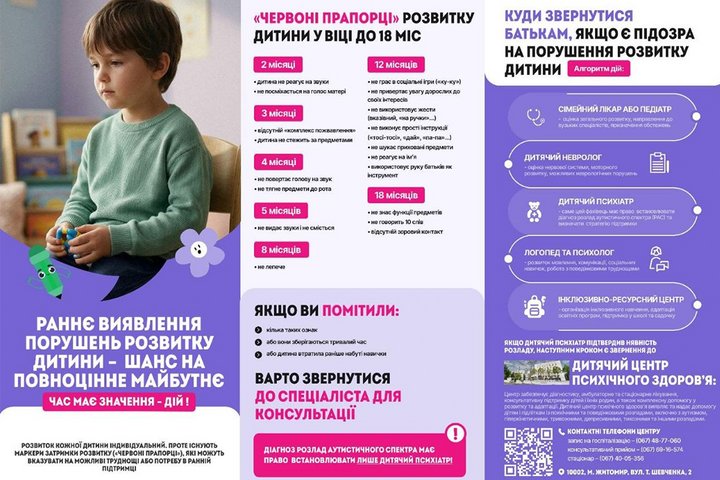
Photo: A booklet that was produced as part of the “I See. I Know. I Act” project. Zhytomyr, April 2026. Courtesy of Maria Tyshchuk.
Tetyana Shevchenko: Regarding expanding the initiative to other regions, our initiative group proposed contacting the expert center responsible for approving treatment protocols and patient pathways. We proposed including our information on early detection of autism spectrum disorders in the Integrated Management of Childhood Illness protocol.
This protocol currently governs the provision of medical care for children up to 5 years in primary healthcare facilities. If our materials are included as a separate supplement, it would be very useful for every medical professional working with patients. This proposal is currently being processed and will be submitted to the Ministry after some adjustments in the near future.
1. ADI-R (Autism Diagnostic Interview – Revised) is a broad diagnostic interview that provides comprehensive information necessary for diagnosing autism and assessing autism spectrum disorders (ASD).
2. A methodology for the comprehensive diagnosis of children from 12 months of age and adults with suspected or confirmed autism spectrum disorders.
The project is implemented with the support of the DOCU/CLUB Network, funded by the Embassy of Sweden in Ukraine, Fondation de France, and the German Marshall Fund of the United States of America.
The opinions, conclusions, or recommendations are those of the authors and compilers of this publication and do not necessarily reflect the views of the governments or charitable organizations of these countries. The authors and compilers are solely responsible for the content of this publication.
All news