

The program combined theory with practice, creating a space for in-depth engagement in film club activities combined with an understanding of how documentary films can serve as tools to discuss important issues, foster community development, and support people in times of challenge.
“It is crucial for us that training of the Network’s moderators does not end with isolated workshops. The mentorship program is a logical continuation of the DOCU/CLUB Network’s learning cycle, where we ensure continuity of knowledge and help moderators apply their newly-gained skills in practice. This leads to sustainability of transformations in communities,” said Nina Khoma, Head of the DOCU/CLUB Network.
Throughout the program, mentees were guided by experienced DOCU/CLUB moderators and mentors – Mariya Symkovych, Oleh Okhredko, Olena Hnatenko, Nataliya Mosentsova, Khrystyna Hatalyak, and Andriy Volyk. The mentors shared their knowledge and expertise, providing mentees with the tools and insights necessary to organize film club activities, from event planning to team building. Participants refined their skills in planning and facilitating documentary screenings and discussions, as well as in creating a safe and open space for dialogue within the film club, which should become more visible and respected within the community.
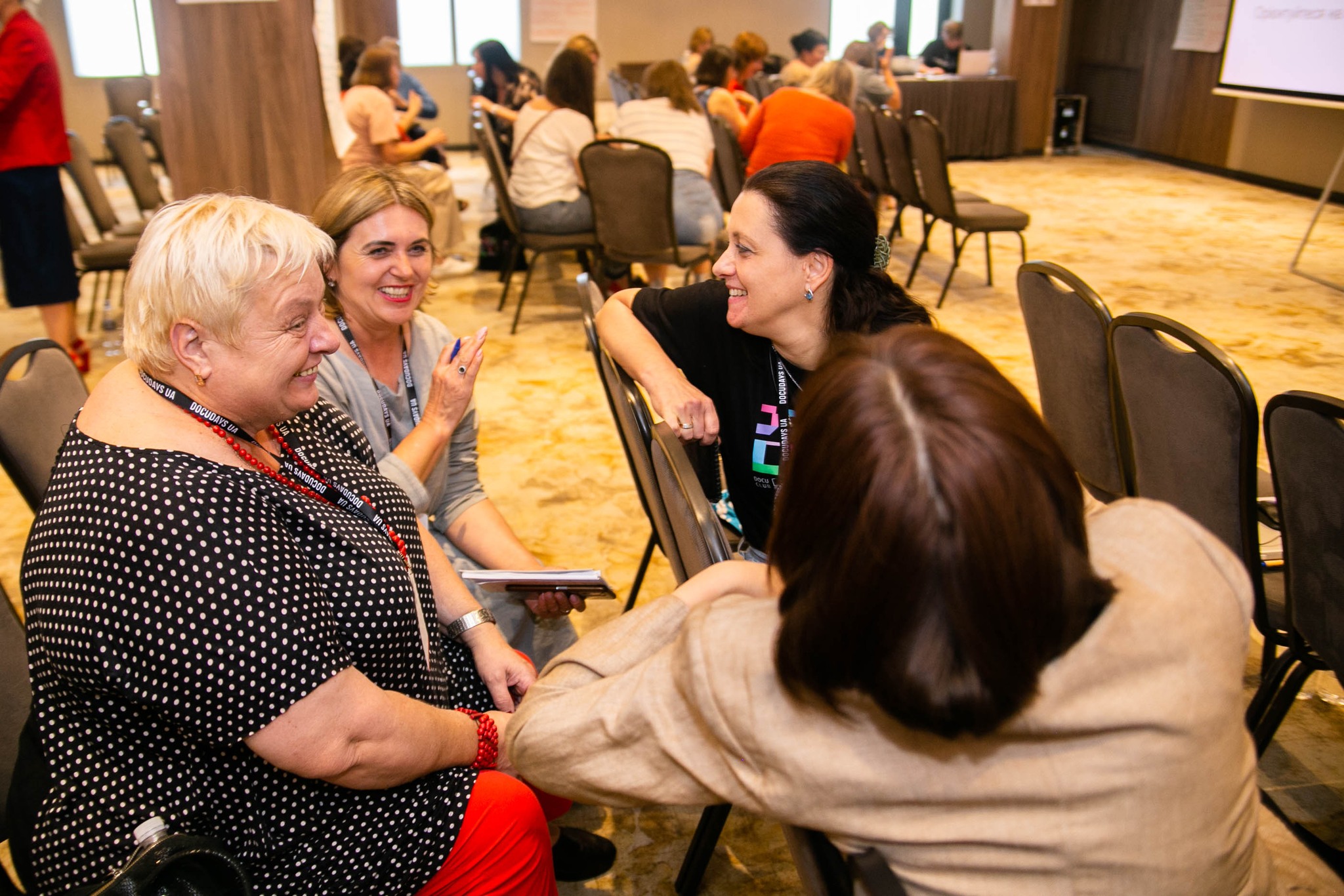
Photo from the DOCU/CLUB Network archive
Mentors of the program dedicated special attention to crisis communication and interaction with vulnerable audience groups, since these issues have become particularly relevant in the context of war. Mentees learned how to respond to difficult situations during screenings, support participants of the discussions, and foster trust and mutual respect within their communities.
“The program flew by so quickly! My mentees went above and beyond, having become greatly inspired to develop their own film clubs. At the beginning, we were simply a group of people brought together by similar professional experience and a shared desire to strengthen civil society. However, DOCU ACTS 4.0 turned us into a real team – one whose members empathize, support, and motivate each other. Previously, my mentees focused mainly on films about the lives and resocialization of convicted people; now, I’ve noticed them choosing films on civic activism and re-development, as well demonstrating greater interest in human rights,” noted Nataliya Mosentsova, the program’s mentor who worked with a group of film club moderators operating within the Probation Center units and correctional facilities.
Mariya Symkovych, mentor of the group of educators, took part in the program for the second time: “I’ve realized that, while teaching others, I also draw inspiration from my own experience and professional journey. When I read my mentees’ reports about their screenings, I see that everything worked out. There is excitement in their eyes, they are filled with desire to work and share experiences, which means our community of moderators continues to grow and evolve.”

Photo from the DOCU/CLUB Network archive
Film club moderators who spent four months mastering the nuances of film club work also shared the results of their learning process.
“I had a specific request related to working with adults, because working with educators is not easy. Our mentor, Oleh Okhredko, explained all the subtleties of engaging an adult audience, and now I feel much more confident in organizing film screenings for my colleagues. The mentor’s support and understanding were crucial for me. Together, we completed many different tasks and generated new ideas. Our meetings were incredibly productive,” said Nataliya Prokopenko, educator, moderator of the film club at the school in Vyrishalne (Poltava region), and participant of the DOCU ACTS 4.0 Mentorship Program.
“We opened the ‘Gart’ film club in a veterans’ community space in Kolomyia long before the start of the mentorship program, but we just did not dare to get to work,” recalls Ella Nemish, moderator of the Docudays UA film club at the ‘Gart’ Support Space. “When I learned about this program, I realized I had to join. The quality of training within the program demonstrates deep respect for the audience, for human rights, and for the mission of the film clubs in general. I feel that I’ve grown as a moderator. I am actively sharing my experience with colleagues, and I notice growing interest in documentary films and observe how a community is being formed around the film club.”
“It was a genuinely positive experience. During the program, I grew as a moderator and started to organize screenings with great enthusiasm. The program helped me launch the active work of my film club. Although the DOCU/CLUB team created an excellent online course for beginners, in-person communication with a mentor has tremendous advantages. It was crucial for me to sort out the technical aspects of organization of screenings and to systematize the knowledge and skills I’d gained. I am very grateful to my mentor, Andriy Volyk, and to our entire team for their immeasurable support and inspiration. I had planned to hold at least one screening during the training, but ended up organizing ten!” shared Serhiy Lyepyokhin, moderator of the film club at the SHELTER+ Cultural and Civic Center in Kryvyi Rih, Dnipropetrovsk region.
The DOCU ACTS 4.0 Mentorship Program became another step toward building a system of ongoing support for moderators within the DOCU/CLUB Network. It ensures continuity in learning from basic training to in-depth guidance, helping each film club turn into a hub of dialogue, trust, support, and action.
We are delighted that, due to mentorship support, moderators confidently continue transforming documentary films into tools for change in their communities, schools, libraries, cultural centers, probation units, and correctional facilities all over Ukraine.
The development of the DOCU/CLUB Network is funded by the Embassy of Sweden in Ukraine, the National Endowment for Democracy (NED) and Fondation de France.
The opinions, conclusions or recommendations are those of the authors and compilers of this publication and do not necessarily reflect the views of the governments or charitable organizations of these countries. The authors and compilers are solely responsible for the content of this publication.
All news