
The event brought together representatives of universities, pedagogical departments, schools, and educational organizations working on developing an innovative educational environment and fostering partnerships between educational institutions.
Erasmus+, the European Union Programme in the spheres of education, vocational training, youth, and sports, provides opportunities for studying, internships, and teaching abroad. It enables students, educators, youth organisations, and other institutions to cooperate, participate in joint projects, and win scholarships.
eTwinning is a branch of the Erasmus+ Programme of the European Commission, which was launched in 2005 to promote international cooperation in the sphere of education. Today, it unites institutions of school, preschool, and vocational education, as well as higher education institutions that train future teachers. Educators from 46 countries across Europe and beyond participate in the Programme.
Therefore, the DOCU/CLUB Network team was delighted to accept the organisers’ invitation and took the opportunity to enhance its cooperation with the educators participating in the Erasmus+/eTwinning Programme.

Olha Babchuk
Olha Babchuk, Communications Manager of the DOCU/CLUB Network, spoke about the work of film clubs in schools and universities, as well as their impact on the development of critical thinking and fostering of democratic citizenship skills. “The communities of the eTwinning ambassadors and film club moderators are agents of innovation in education who strive to make the learning process up-to-date, meaningful, and responsive to the needs of children and youths. We are united by a vision of education as a space for partnership, openness, respect, and strengthening of civil society. It was therefore a great pleasure to see vivid interest in the Network’s presentation among the training participants,” Olha noted.

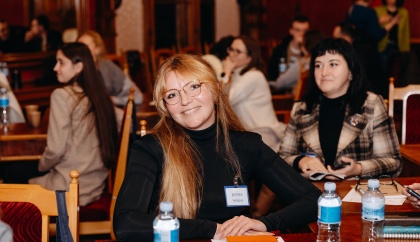
Training participants listening to the presentation about the work of film clubs at schools and universities.
The training participants actively engaged in the discussion. Their questions concerned both the methodology of using documentary films and the possibilities of integrating film clubs into school partnerships and international projects.
“One thing that impressed me most was how well-structured the work of the film clubs is: there are methodological materials, trainings, and support for moderators. It is an ideal tool for project-based activities at schools,” noted one of the educators present in the room. Another participant, a student of a pedagogical university, remarked that the film-club format “helps address complex topics and enables their open discussion, which is crucial for future educators.”

The participants are listening attentively about the ways film clubs help foster critical thinking
During the presentation, the discussion also touched upon the strategic expansion of cooperation with film clubs, most specifically, at schools. “The partnership with eTwinning and its active community are of vital importance for us,” emphasized Nina Khoma, Head of the DOCU/CLUB Network. “We see great potential in making film clubs part of such European educational initiatives. Thus, documentary films will enable pupils and students to learn not only about human rights, but also about their country, its history and contemporary challenges.”
The meeting in Chernivtsi became an important step toward strengthening cooperation between the DOCU/CLUB Network and the schools and universities participating in the European Commission’s Erasmus+/eTwinning Programme. It demonstrated that the demand for high-quality civic education tools is growing, and that documentaries effectively respond to this demand.
The development of the DOCU/CLUB Network is funded by the Embassy of Sweden in Ukraine, the National Endowment for Democracy (NED) and Fondation de France.
The opinions, conclusions or recommendations are those of the authors and compilers of this publication and do not necessarily reflect the views of the governments or charitable organizations of these countries. The authors and compilers are solely responsible for the content of this publication.
All news