
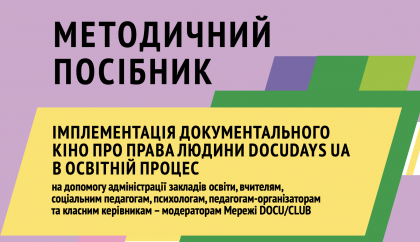
The handbook was written by Maria Symkovych, seasoned moderator of a Docudays UA film club, director of the NGO “Insider” Center for Education, and co-founder and director of the “Caritas School” for additional education in Uzhhorod. Drawing on her own experience that comprises many years and a deep understanding of the needs of modern schools, she has created a comprehensive guide, which will help turn documentary films into an integral part of school life.
The publication is designed as a handbook for the entire schooling community: school administrators, subject teachers, grade tutors, social pedagogues, psychologists, and educational coordinators.
The handbook is structured in a way that allows educators quickly find a suitable tool for a specific purpose:
-
Methodological framework: educational potential of documentaries, principles of film selection, and interactive methods for working with audiences.
-
Digitalization: using modern online tools in order to engage students during the screenings.
-
Ready-made solutions: specific methodological recommendations for lessons in history, law, civic education, biology, geography, computer science, and Ukrainian language.
-
Extracurricular activities: scenarios for use of films for career guidance, student self-government activities, and methodological support of teachers.
Every film is supplemented with a list of thematic questions, key competences, and narrative threads that correspond to modern standards of education.

Photo from the DOCU/CLUB Network archive
“This handbook bridges the world of documentary filmmaking and the school curriculum. We intended to prove that documentaries are not an additional workload – they are a powerful resource that sparks students’ interest in lessons and helps teachers become facilitators of important senses,” says Maria Symkovych, author of the handbook.
Why is it useful for educators and students?
The methodological handbook facilitates the process of educators’ preparation to lessons and pedagogical work. The structured guideline helps save time, since teachers do not have to come up with their own questions for film discussions or look for their connections with the school program. Documentary films help integrate the theme of human rights even into natural or technical disciplines. The section containing international legislation and norms is especially valuable for educators. References to the crucial international documents regarding human rights will enable teachers to ground film discussions in global standards, helping students develop a comprehensive understanding of the global human rights protection system.

Photo from the DOCU/CLUB Network archive
Using the handbook will make the learning process engaging and meaningful for students. By discussing real-life stories from the documentaries, children will learn to analyze manipulations, stereotypes, and complex social processes, which is key to the development of critical thinking. Documentaries develop empathy and ability to understand other people’s experiences, while fostering the students’ civic engagement and motivating them to be active members of the community.
Nina Khoma, Head of the DOCU/CLUB Network, noted: “Publication of this handbook is a crucial event for our community. We are proud that the expertise of our moderators has resulted in such a comprehensive work. It is important for the Network that documentary films become not only a form of entertainment, but also an effective tool for transforming education and fostering students’ development. The handbook by Maria Symkovych will help school teachers and administrations integrate human rights education into the daily school curriculum in a professional, engaging, and relevant manner. We are confident that today’s Ukrainian educational establishments need this form of reinforcing their methodological foundations.”
The DOCU/CLUB Network is convinced this handbook will become a reliable resource for hundreds of educators who strive to educate and foster free, responsible, and critically thinking citizens.
The project is implemented with the support of the DOCU/CLUB Network, funded by the Embassy of Sweden in Ukraine and Fondation de France.
The opinions, conclusions or recommendations are those of the authors and compilers of this publication and do not necessarily reflect the views of the governments or charitable organizations of these countries. The authors and compilers are solely responsible for the content of this publication.