
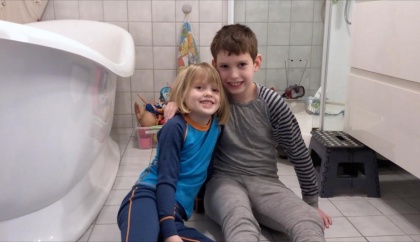
The meeting was dedicated to the screening of the documentary film Karla & Nordahl. This chamber film by Norwegian filmmaker Elisabeth Aspelin does not offer premade solutions — rather, it urges the viewer to look closely at the everyday life of childhood, which brings together love, care, and fatigue. The screening provided an occasion for a frank and profound conversation about empathy, support, and culture of acceptance in Ukrainian society.
The film focuses on 6-year-old Karla and her older brother Nordahl. Observing the children during the winter months, the director creates a delicate portrait of their daily lives without excessive dramatization and explanations. The camera does not impose judgments – it acts as a neighbor passing by the window and waving: “Hello, Karla,” as one of the discussion participants noted.
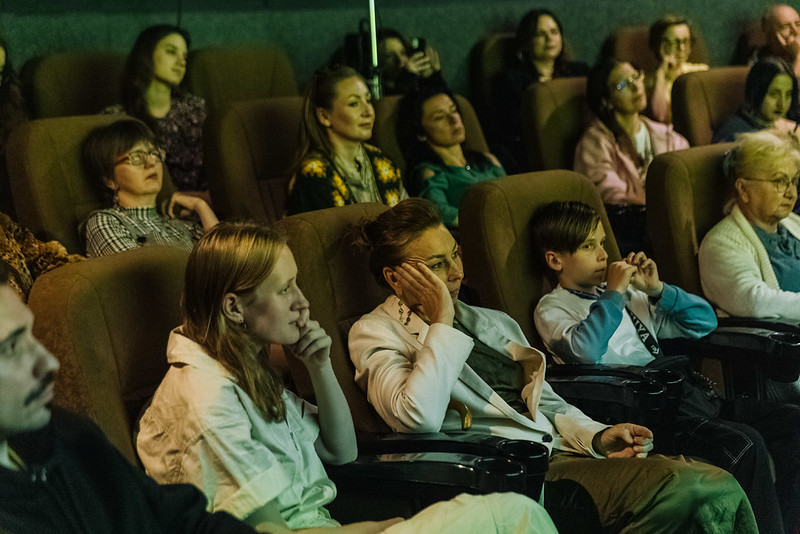
Photo from the archive of the NGO Docudays
The viewers repeatedly emphasized that the tone of the film is calm, attentive, and free from manipulation. “The girl is amazing, and the director’s camera is very delicate,” said one of the pedagogues who “fell in love” with the protagonist. At the same time, participants noted that the film does not idealize relationships: it contains both conflicts and moments of detachment between children, which makes the story convincing.
“How can I be of assistance?”
After the screening, moderator Olha Babchuk offered to the participants the interactive exercise “How can I be of assistance?”. In small groups, viewers came up with specific steps to help families that have children with disabilities.
Among the voiced ideas were creation of daycare centers, social support for children and parents, inclusive summer camps, and possibilities for short-term “respites” for the family members. At the same time, the participants emphasized that any support should begin with a request from the family and be provided with respect towards the family’s boundaries. “First of all, you should ask them, ‘May I help you?,’ and only then resort to action,” said one of the participants.
The commentary from a mother raising a child with a severe disability was especially emotional: “When you see such a child, don’t look away, just smile… You need to see the person behind the diagnosis.” Her words about sincerity, respect, and the need for acceptance became the leitmotif of the meeting.
The context that cannot be ignored
Participants in the discussion reiterated one point: the issue of support for people with disabilities is becoming increasingly urgent in Ukraine, especially since the start of the full-scale invasion. The number of families in need for help keeps growing, and the state-provided support mechanisms do not always keep up with these challenges. Therefore, the formation of a culture of acceptance is not merely an abstract idea, but an urgent social need.
“The easiest thing to do is to ask and hear the answer,” one of the participants shared her experience. This simple advice seems to have summed up the conversation: honesty, openness, and willingness to admit that “I don’t know something, but I’m eager to learn” could become the first steps towards real inclusivity.
Once again, the Docudays UA online film club confirmed its role as a platform where documentary cinema becomes a tool for social dialogue. The film Karla and Nordahl does not offer ready-made solutions. Instead, it offers to watch, hear, and feel.
As one of the viewers wrote in the chat after the screening, many people “took away from this conversation the emotion of love just for being yourself.”
The project is implemented with the support of the DOCU/CLUB Network, funded by the Embassy of Sweden in Ukraine and Fondation de France.
The opinions, conclusions or recommendations are those of the authors and compilers of this publication and do not necessarily reflect the views of the governments or charitable organizations of these countries. The authors and compilers are solely responsible for the content of this publication.
All news