
Time and again, documentary films presented occasions to come together, take a closer look at reality, and discuss issues that trouble us, concern us, or call for reflections. These meetings constitute our year’s review in numbers, geography, and shared meanings.
Events and audiences: A never-ending conversation
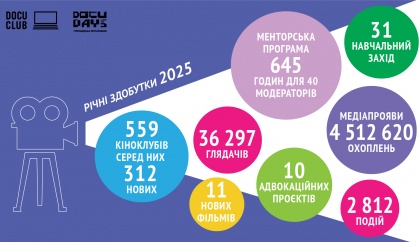
Over the course of the year, 2,812 events were held within the DOCU/CLUB Network’s film clubs in online, offline, and hybrid formats. In other words, about 8 screenings and discussions of documentary films from our collection took place every day in different parts of Ukraine and abroad. The formats of these events varied from cozy gatherings at libraries, schools, probation units, and correctional facilities to large-scale public discussions, but all of them had one crucial feature in common: they were conversations with and about audiences.
A total of 36,297 viewers took part in these events. For some, this was their first encounter with documentary cinema; for others, film clubs became a space of support; and for many, they served as a catalyst for action and positive change.
The Network is expanding beyond Ukraine’s borders
At the end of this year, the DOCU/CLUB Network comprises 559 film clubs working at schools, libraries, universities, NGOs, culture spaces, probation units, and correctional facilities. All these film clubs make documentary films on human rights an integral part of community life.
This year’s distinctive feature was active growth: 312 new film clubs opened in 2025 alone. Such growth reflects a demand for this format of engagement within communities, as well as their trust in the Network as a platform for human rights education, development, and support.
The international expansion of the Network deserves a special mention. Currently, the DOCU/CLUB Network includes 23 film clubs operating in 17 foreign countries: Germany, Azerbaijan, Belgium, Switzerland, Latvia, Italy, the United Kingdom, Spain, Canada, the Netherlands, Norway, Mauritania, Japan, France, China, Hungary, and the Republic of the Congo.
Six of these film clubs work under the auspices of Ukrainian embassies. This demonstrates that discussions about Ukraine, human rights, and our experience of war continue far beyond the country’s borders.
Visibility and trust: Media presence
In 2025, information about the DOCU/CLUB Network reached 4,512,620 people through media outlets and social networks, including:
- 248,036 website views that indicate constant interest in the Network’s news, materials, and resources;
- 2,569,400 social media users who learned about film club events and activities and familiarized themselves with the film club community;
- 1,695,184 people have read about the Network in the media, which results from cooperation with journalists and editorial teams that present documentary films as socially significant tools and share stories about film clubs’ moderators.
Training and support for moderators
High-quality work of film clubs is impossible without continuous learning. Over the course of the year, the Network team conducted 31 training events for film club moderators and external audiences, including educators, police officers, prosecutors, youth workers, civic activists, and students. While the formats and topics of these trainings varied, they shared a common objective: building the capacity to work with documentary film in a responsible and sensitive manner.
A distinct part of the training process was the DOCU ACTS 4.0 mentorship program, which lasted five months and comprised 645 hours of work. The program engaged 40 moderators, both newcomers and those seeking to deepen their knowledge and skills. This annual program remains the Network team’s strategic investment into sustainability and ongoing development of the film club community.
Advocacy and new films
In 2025, the DOCU/CLUB Network launched 10 advocacy projects aimed at systemic transformations within communities, engaging a broad range of target groups. Within these initiatives, documentary films once again served as tools for argumentation, dialogue, promotion of democratic reforms, and influence on local authorities.
This year, the Network’s collection was enriched by 11 new films, including: Witnesses. Captivity Kills and Kherson. Resistance Continues by Tetiana Symon; The Cleaners by Hans Block and Moritz Riesewieck; 20 Days in Mariupol by Mstyslav Chernov; Near Light by Niccolò Salvato; Roses. Film-Cabaret by Iryna Stetsenko; Intercepted by Oksana Karpovych; Ukrainian Factory: Two Years of War For a Mykolaiv Key Worker by Olha Zhurba; A Day Off by Zhanna Maksymenko-Dovhych; Lifelong Songs by Ulyana Osovska; and As Far As Possible by Hanna Yaroshevych.
In the coming year 2026, these films will become part of hundreds of screenings and discussions at the Docudays UA film clubs.
As the year draws to a close, the Network team would like to express sincere gratitude to the film club moderators who incessantly dedicate their time and energy to work under conditions of uncertainty and wartime challenges, skillfully finding the right words for difficult conversations. Due to your efforts, film clubs become spaces of mutual trust, where film discussions evolve into meaningful interactions and support between viewers.
Thank you for your consistency, sensitivity, and belief in the power of documentary cinema. You and your commitment are the foundation of the DOCU/CLUB Network.
We extend our sincere gratitude to our partners – state institutions, NGOs, and initiatives – for your cooperation and shared commitment. Our partnerships enable us to expand audiences, adapt formats to the needs of diverse communities, and jointly seek responses to the complex challenges of our time. In cooperation with you, film club moderators create safe spaces for discussion, support local communities, and engage in the Network’s advocacy projects. This shared involvement makes the work of film clubs vibrant, sensitive, and grounded in the needs of specific communities.
Beyond any doubt, the work of the DOCU/CLUB Network would not be possible without our donors, who enable film clubs to develop, learn, and grow. Trust and support of international partners allow the Network team to launch new programs, expand the film collection, support moderators, and engage diverse audiences in Ukraine and abroad.
We are deeply grateful for this support and for partnerships that help sustain people during the war, reflect on reality, strengthen communities, implement positive change, and advance democratic reforms through documentary films.
The development of the DOCU/CLUB Network is funded by the Embassy of Sweden in Ukraine, the National Endowment for Democracy (NED), and Fondation de France.
The opinions, conclusions or recommendations are those of the authors and compilers of this publication and do not necessarily reflect the views of the governments or charitable organizations of these countries. The authors and compilers are solely responsible for the content of this publication.